Le groupe B.M.P.T. est un mouvement d’art conceptuel dont le sigle reprend les initiales des quatre membres : Buren, Mosset, Parmentier, Toroni.
Dans ce mouvement éphémère (décembre 1966 à décembre 1967), chaque artiste définit et utilise un élément graphique (les bandes horizontales, les bandes verticales, le cercle, les touches) qui devient le point de départ d’un vocabulaire pictural et esthétique qui lui est propre.
Le groupe B.M.P.T s’oppose de manière radicale aux artistes parisiens et à l’Ecole de Paris. Les artistes revendiquent le degré zéro de la peinture, fondant leur pratique sur la répétition d’un même motif. La peinture se résume à sa seule et simple matérialité, elle est uniquement un médium.
The B.M.P.T. group is a movement of conceptual art whose acronym takes again the initials of the four members : Buren, Mosset, Parmentier, Toroni.
In this ephemeral movement (December 1966 to December 1967), each artist defines and uses a graphic element (the horizontal bands, the vertical bands, the circle, the keys) which becomes the starting point of a pictorial vocabulary and aesthetic which is him own.
The B.M.P.T group opposes in a radical way to the parisian artists and to the School of Paris. The artists claim the zero degree of painting, basing their practice on the repetition of the same pattern. Painting is reduced to its simple materiality, it is only a medium.
Il gruppo B.M.P.T. è un movimento artistico concettuale il cui acronimo prende le iniziali dei suoi quattro membri : Buren, Mosset, Parmentier, Toroni.
In questo movimento di breve durata (dicembre 1966 - dicembre 1967), ogni artista definisce e utilizza un elemento grafico (strisce orizzontali, strisce verticali, cerchi, tocchi) che diventa il punto di partenza di un vocabolario pittorico e di un’estetica che gli è propria.
Il gruppo B.M.P.T. si oppone radicalmente agli artisti parigini e all’Ecole de Paris. Gli artisti rivendicano il grado zero della pittura, basando la loro pratica sulla ripetizione dello stesso motivo. La pittura è ridotta alla sua semplice materialità, è solo un mezzo.
Abstrait
Abstract
Astratto
Est abstraite, ou non figurative, une œuvre qui ne représente pas de sujet reconnaissable. L’art abstrait est une tendance artistique qui apparaît au début du XXe siècle.
Abstract, or non-figurative, is a work that does not represent a recognisable subject. Abstract art is an artistic trend that emerged in the early 20th century.
Astratto, o non figurativo, è un lavoro che non rappresenta un soggetto riconoscibile. L’arte astratta è una tendenza artistica emersa all’inizio del XX secolo.
Atelier
Workshop
Studio
Lieu de travail et, accessoirement, le logement d’un artiste. Il était, du XIXe siècle jusqu’à la Première Guerre mondiale, un lieu culturel important où s’est développée toute une convivialité non seulement dans le domaine des arts mais aussi de la littérature et de la création en règle générale.
A place of work and, incidentally, the home of an artist. From the 19th century until the First World War, it was an important cultural place where a whole conviviality developed, not only in the field of art but also in literature and creation in general.
Un luogo di lavoro e, incidentalmente, la casa di un artista. Dal XIX secolo fino alla prima guerra mondiale, fu un importante luogo culturale dove si sviluppò tutta una convivialità, non solo nel campo dell’arte ma anche della letteratura e della creazione in generale.
Bichromie
Bichromy
Bicromia
En peinture, la bichromie est un procédé qui utilise seulement deux couleurs. Une technique plutôt associée à l’impression mécanique et industrielle d’images et qui inspire les artistes du courant BMPT car ils y voient un aspect dépourvu d’émotions.
In painting, two-colour printing is a process that uses only two colours. A technique rather associated with the mechanical and industrial printing of images and which inspires the artists of the BMPT current because they see it as devoid of emotion.
In pittura, la bicromia è un processo che utilizza solo due colori. Una tecnica piuttosto associata alla stampa meccanica e industriale delle immagini e che ispira gli artisti della corrente BMPT perché la vedono come priva di emozione.
Degré 0
Degree 0
Grado 0
En peinture, le degré 0 est le fait de réduire volontairement la peinture à son statut d’objet. La peinture est simplifiée à son maximum, nettoyée de tout élément propre à susciter l’émotion. Le terme degré 0 est employé par les membres du groupe BMPT dans les années 1960 en opposition à des courants artistiques jugés trop élitistes. Toutefois, l’expression est employée la première fois en 1915 pour qualifier la peinture suprématiste de Kasimir Malevitch Carré Noir sur Fond Blanc.
In painting, the degree 0 is the voluntary reduction of the painting to its status of object. The painting is simplified to its maximum, cleaned of any element that might arouse emotion. The term degree 0 was used by the members of the BMPT group in the 1960s in opposition to artistic currents considered too elitist. However, the term was first used in 1915 to describe Kasimir Malevich’s Suprematist painting Black Square on White Background.
In pittura, il grado 0 è la riduzione volontaria della pittura al suo status di oggetto. Il quadro è semplificato al massimo, ripulito da qualsiasi elemento che possa suscitare emozioni. Il termine grado 0 fu usato dai membri del gruppo BMPT negli anni ’60 in opposizione alle correnti artistiche considerate troppo elitarie. Tuttavia, il termine fu usato per la prima volta nel 1915 per descrivere il dipinto suprematista di Kasimir Malevich Quadro nero su sfondo bianco.
Élément graphique
Graphic element
Elemento grafico
Ensemble de procédés propre à un artiste et qui lui sert à représenter des signes sur une surface. Les peintres du groupe BMPT utilisent des éléments graphiques distincts qui représentent en quelque sorte leur signature.
A set of procedures specific to an artist and which serves to represent signs on a surface. The painters of the BMPT group use distinct graphic elements that represent their signature.
Insieme di processi specifici di un artista e che gli servono per rappresentare segni su una superficie. I pittori del gruppo BMPT usano elementi grafici distinti che rappresentano una sorta di firma.
EMPREINTEPRINTINGSTAMPA
Trace laissée par quelque chose ou quelqu’un, sous l’action de son poids, de son déplacement ou de son frottage. Cette technique est utilisée par Niele Toroni qui appose sur ses toiles l’empreinte d’un pinceau.
A trace left by something or someone through the action of its weight, movement or rubbing. This technique is used by Niele Toroni who applies the imprint of a brush to his canvases.
Una traccia lasciata da qualcosa o qualcuno sotto l’azione del suo peso, movimento o sfregamento. Questa tecnica è usata da Niele Toroni che applica l’impronta di un pennello alle sue tele.
INSITUINSITUINSITUAZIONE
In situ du latin : dans l’endroit même. Par extension : dans le lieu où quelque chose se trouve, dans son cadre naturel, à sa place normale, habituelle.
Sur le plan artistique, ce terme est employé pour qualifier des œuvres d’art non déplaçables imaginées et crées pour et dans un espace précis. L’œuvre in situ dialogue avec l’espace dans lequel elle existe. Daniel Buren, artiste du mouvement B.M.P.T. revendique le caractère in situ de certaines de ses œuvres, terme qu’il est le premier à employer artistiquement et dont il fait son mode de travail principal.
In situ from Latin : in the same place. By extension : in the place where something is, in its natural setting, in its normal, usual place.
In artistic terms, this term is used to describe non-displaceable works of art imagined and created for and in a specific space. The in situ work is in dialogue with the space in which it exists. Daniel Buren, an artist of the B.M.P.T. movement, claims the in situ character of some of his works, a term he was the first to use artistically and which he makes his main mode of work.
In situ dal latino : nel luogo stesso. Per estensione : nel luogo dove si trova qualcosa, nel suo ambiente naturale, nel suo posto normale, abituale.
In termini artistici, questo termine è usato per descrivere opere d’arte non mobili immaginate e create per e in uno spazio specifico. L’opera in situ è in dialogo con lo spazio in cui esiste. Daniel Buren, artista del movimento B.M.P.T., rivendica il carattere in situ di alcune delle sue opere, termine che è stato il primo a usare artisticamente e che fa della sua principale modalità di lavoro.
INTERVALLEINTERVALINTERVALLO
On utilise le mot intervalle pour définir la distance entre deux choses (lieux, points, objets, sons, etc.). L’intervalle peut désigner le vide entre deux choses ou encore le moment d’interruption au cours d’une représentation, d’un jeu. En musique l’intervalle désigne l’écart entre les hauteurs de deux notes.
The word interval is used to define the distance between two things (places, points, objects, sounds, etc.). The interval can refer to the gap between two things or to the moment of interruption during a performance or a game. In music, the interval refers to the difference between the pitches of two notes.
La parola intervallo si usa per definire la distanza tra due cose (luoghi, punti, oggetti, suoni, ecc.). L’intervallo può designare il vuoto tra due cose o il momento di interruzione durante una performance o un gioco. In musica l’intervallo si riferisce alla differenza tra le altezze di due note.
MATERIALITÉ
MATERIALMATERIALE
La matérialité désigne le fait d’être constitué de matière ainsi que les circonstances matérielles qui constituent quelque chose.
Dans le champ des arts plastiques, la matérialité d’une œuvre correspond à l’ensemble des éléments concrets (support, matériaux, matières) qui la constituent ou qui nous renseignent sur sa création (trace du geste de l’artiste, d’outils, etc.).
Materiality refers to the fact of being made of matter as well as the material circumstances that constitute something.
In the field of the plastic arts, the materiality of a work corresponds to all the concrete elements (support, materials, matter) which constitute it or which inform us about its creation (trace of the artist’s gesture, of tools, etc.).
La materialità si riferisce al fatto di essere fatto di materia così come alle circostanze materiali che costituiscono qualcosa.
Nel campo delle arti visive, la materialità di un’opera corrisponde a tutti gli elementi concreti (supporto, materiali, materia) che la costituiscono o che ci informano sulla sua creazione (traccia del gesto dell’artista, strumenti, ecc.)
MÉCANIQUEMECHANICALMECCANICO
Mécanique se dit de ce qui est produit, exécuté, actionné par une machine, un mécanisme. Ce terme s’emploie également pour désigner ce qui est machinal, qui se fait sans l’aide de la réflexion ou de la volonté, par exemple : des gestes mécaniques.
Mechanical refers to what is produced, executed, operated by a machine, a mechanism. This term is also used to designate that which is mechanical, which is done without the help of reflection or will, for example : mechanical gestures.
Meccanico si riferisce a ciò che è prodotto, eseguito, azionato da una macchina, un meccanismo. Questo termine si usa anche per designare ciò che è meccanico, che si fa senza l’aiuto della riflessione o della volontà, per esempio : i gesti meccanici.
MINIMALMINIMALMINIMO
Qui atteint sa plus petite valeur, son plus bas degré, son minimum.
L’Art Minimal ou Minimalisme est un courant de l’art contemporain né dans les années 60 aux Etats-Unis, dans lequel l’intervention de l’artiste est réduite à son minimum, l’œuvre réduite à des formes d’une extrême simplification géométrique, ainsi qu’à des modalités élémentaires de matière ou de couleur.
That which reaches its lowest value, its lowest degree, its minimum.
Minimal Art or Minimalism is a current of contemporary art born in the 1960s in the United States, in which the artist’s intervention is reduced to its minimum, the work reduced to forms of extreme geometric simplification, as well as to elementary modalities of matter or colour.
Ciò che raggiunge il suo valore più basso, il suo grado più basso, il suo minimo.
La Minimal Art o Minimalismo è una corrente dell’arte contemporanea nata negli anni 60 negli Stati Uniti, in cui l’intervento dell’artista è ridotto al minimo, l’opera ridotta a forme di estrema semplificazione geometrica, così come a modalità elementari di materia o colore.
Monochrome signifie qui est d’une seule couleur. La monochromie est le terme employé pour désigner le caractère de ce qui est d’une seule couleur.
Dans le domaine de l’art, un monochrome désigne également un type d’œuvres : toile ou autre surface recouverte entièrement d’une même couleur par un artiste.
Monochrome means which is of one colour. Monochrome is the term used to designate the character of that which is of a single colour.
In art, a monochrome also refers to a type of work : canvas or other surface covered entirely with one colour by an artist.
Monocromatico significa che è di un solo colore. Monocromatico è il termine usato per designare il carattere di ciò che è di un solo colore.
In arte, un monocromo si riferisce anche a un tipo di opera : tela o altra superficie coperta interamente da un solo colore da un artista.
MOTIFPATTERNMOTIVO
Sujet qui domine une œuvre d’art, un ouvrage. Ce peut être un dessin, un ornement, le plus souvent répété, sur un support quelconque, par exemple un tissu à motifs floraux.
Chaque artiste du mouvement d’art contemporain B.M.P.T. a son propre motif comme vocabulaire pictural ; les bandes pour Daniel Buren et Michel Parmentier, le cercle pour Olivier Mosset et la répétition d’empreintes de pinceau n°50 pour Niele Toroni.
Dessiner/peindre sur le motif est également un terme employé pour qualifier l’action de dessiner/peindre directement devant le paysage que l’on souhaite représenter.
Subject that dominates a work of art, a work. It may be a design, an ornament, usually repeated, on some kind of support, for example a fabric with floral patterns.
Each artist in the contemporary art movement B.M.P.T. has his or her own motif as a pictorial vocabulary ; the stripes for Daniel Buren and Michel Parmentier, the circle for Olivier Mosset and the repetition of brushstrokes n°50 for Niele Toroni.
Drawing/painting on the motif is also a term used to describe the action of drawing/painting directly in front of the landscape one wishes to represent.
Soggetto che domina un’opera d’arte, un’opera. Può essere un disegno, un ornamento, il più delle volte ripetuto, su qualsiasi supporto, per esempio un tessuto con motivi floreali.
Ogni artista del movimento di arte contemporanea B.M.P.T. ha il proprio motivo come vocabolario pittorico ; le strisce per Daniel Buren e Michel Parmentier, il cerchio per Olivier Mosset e la ripetizione di pennellate n°50 per Niele Toroni.
Disegnare/dipingere sul motivo è anche un termine usato per descrivere l’azione di disegnare/dipingere direttamente davanti al paesaggio che si vuole rappresentare.
PEINTUREPAINTINGPITTURA
Matière colorante composée d’un pigment et d’un liant, utilisée pour recouvrir une surface, pour la protéger ou l’orner. Elle peut désigner également l’art de peindre dont se sont saisi de nombreux mouvements artistiques, les réalisations des artistes peintres et l’œuvre elle-même (tableau, fresque…) faite de couleurs étalées sur une surface.
A colouring material composed of a pigment and a binder, used to cover, protect or decorate a surface. It can also refer to the art of painting, which has been taken up by many artistic movements, the achievements of painters and the work itself (painting, fresco, etc.) made up of colours spread over a surface.
Una materia colorante composta da un pigmento e un legante, usata per coprire una superficie, per proteggerla o per adornarla. Può anche riferirsi all’arte della pittura, che è stata ripresa da molti movimenti artistici, alle realizzazioni dei pittori e all’opera stessa (pittura, affresco, ecc.) fatta di colori stesi su una superficie.
Le pliage désigne l’action ou la manière de plier, c’est-à-dire rabattre sur elle-même une matière souple dans le but d’obtenir plusieurs épaisseurs, une forme déterminée ou d’en réduire le format.
Le dépliage désigne l’action de défaire, étendre, ouvrir ce qui est plié.
Certains artistes ont également exploré le pliage/dépliage comme façon de peindre. C’est le cas notamment de Simon Hantaï célèbre pour ses pliages de toiles créant lorsqu’ils sont dépliés, des formes aléatoires colorées. Cette technique inspire Michel Parmentier, artiste du mouvement B.M.P.T. dont les pliages de toiles donnent après dépliage des bandes colorées.
Folding refers to the action or manner of folding, i.e. folding a flexible material over itself in order to obtain several thicknesses, a given shape or to reduce its size.
Unfolding refers to the action of undoing, extending, opening what is folded.
Some artists have also explored folding/unfolding as a way of painting. This is the case of Simon Hantaï, famous for his folded canvases which, when unfolded, create random coloured shapes. This technique inspires Michel Parmentier, an artist of the B.M.P.T. movement, whose folded canvases produce coloured bands when unfolded.
La piegatura si riferisce all’azione o al modo di piegare, cioè ripiegare su se stesso un materiale flessibile allo scopo di ottenere diversi spessori, una forma definita o di ridurre le dimensioni.
Dispiegare si riferisce all’azione di disfare, estendere, aprire ciò che è piegato.
Alcuni artisti hanno anche esplorato la piegatura/svolgimento come un modo di dipingere. È il caso di Simon Hantaï, famoso per le sue tele piegate che, una volta dispiegate, creano forme colorate casuali. Questa tecnica ispira Michel Parmentier, artista del movimento B.M.P.T., le cui tele piegate producono bande colorate quando vengono aperte.
RÉPÉTITIONREPETITIONRIPETIZIONE
La répétition désigne l’action de refaire quelque chose plusieurs fois.
En architecture et en peinture, cela désigne la reproduction à des intervalles réguliers d’un même sujet ou motif.
Repetition is the act of doing something over and over again.
In architecture and painting, it refers to the reproduction at regular intervals of the same subject or motif.
La ripetizione si riferisce all’azione di fare qualcosa più e più volte.
In architettura e in pittura, si riferisce alla riproduzione a intervalli regolari dello stesso soggetto o motivo.
RYTHMERYTHMRYTHM
Retour, à des intervalles réguliers dans le temps, d’un fait, d’un phénomène.
Dans une œuvre plastique ou architecturale on peut parler du rythme de la composition, pour désigner l’ordre, l’équilibre résultant de la proportion et de l’agencement de ses parties.
Return, at regular intervals in time, of a fact, a phenomenon.
In a plastic or architectural work we can speak of the rhythm of the composition, to designate the order, the balance resulting from the proportion and arrangement of its parts.
Ritorno, a intervalli regolari nel tempo, di un fatto, di un fenomeno.
In un’opera plastica o architettonica possiamo parlare di ritmo della composizione, per designare l’ordine, l’equilibrio risultante dalla proporzione e dalla disposizione delle sue parti.
Le vocabulaire pictural désigne un répertoire de formes, de couleurs, ou tout autre élément propre à la peinture choisi par un artiste afin d’exprimer ses idées à travers ses œuvres.
The vocabulary of painting refers to a repertoire of shapes, colours, or any other element specific to painting chosen by an artist to express his ideas through his works.
Il vocabolario pittorico si riferisce a un repertorio di forme, colori o qualsiasi altro elemento peculiare della pittura scelto da un artista per esprimere le sue idee attraverso le sue opere.
Daniel Buren
Boulogne-Billancourt 1938
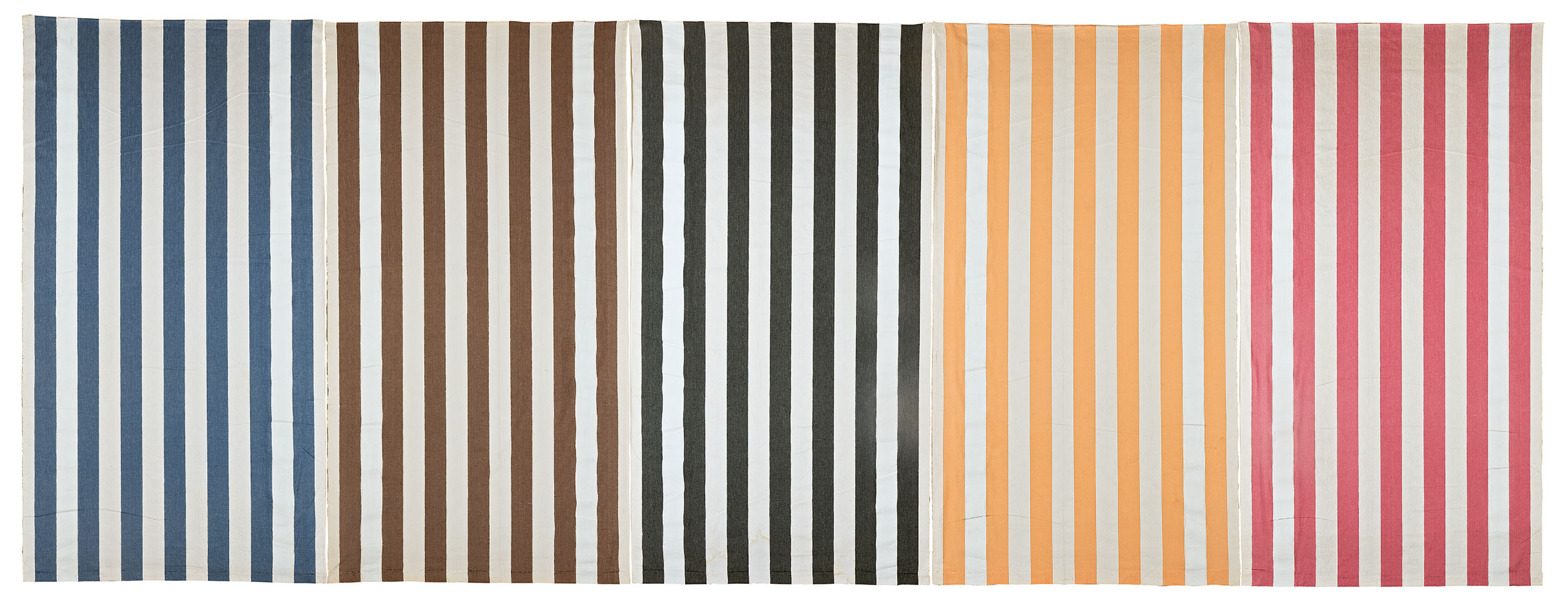
Daniel Buren suit les cours de l’Ecole des Métiers d’Art. A partir de 1965, il met au point sa technique artistique, symbole de son oeuvre : il peint des bandes verticales de 8,7 cm de largeur, alternées blanches et colorées, sur des tissus pré-imprimés. En 1966, il crée avec trois autres artistes le groupe B.M.P.T.Buren réduit au minimum son travail en utilisant des matériaux préfabriqués (tissus et toiles imprimés, papiers imprimés, verres peints et gravés, plastiques, bois, etc.). Par cette radicalité, il cherche à débarrasser l’œuvre de toute sensibilité et à la rendre la plus neutre possible en intervenant au minimum dans son processus de création.
Buren est également le premier artiste à employer le terme in situ. Dès 1968, il investit l’espace urbain et s’intéresse de plus en plus aux liens entre architecture et art. Il crée et montre ses œuvres en fonction d’un lieu précis.
Sans titre, 1971
Peinture sur cinq panneaux de tissu 244 x 124 cm (chaque élément) Achat avec l’aide du FRAM, 1982
Inv. 982.6.102.1-5
C’est en 1971 que Daniel Buren réalise l’œuvre Sans titre, composée de cinq panneaux de tissu sur lesquels l’artiste peint des bandes blanches et colorées de 8,7 cm de manière alternée. Ces rayures forment l’outil visuel que développe Daniel Buren en 1965 à la suite de la découverte de toiles de store rayées au marché Saint Pierre à Paris.
Dans cette peinture, à chaque panneau correspond une couleur alternée de blanc, présentée par ordre alphabétique : bleu, marron, noir, orange et rouge. L’œuvre est pensée dans son ensemble : les cinq panneaux sont accolés et se raccordent entre eux sans interruption grâce à la succession des bandes colorées et blanches.
La continuité, la répétition et le rythme du motif présents dans Sans titre sont des éléments essentiels dans les créations de Daniel Buren.
Daniel Buren
Boulogne-Billancourt 1938
Daniel Buren attended the Ecole des Métiers d’Art. From 1965, he develops his artistic technique, symbol of his work: he paints vertical strips of 8.7 cm wide, alternating white and colored, on pre-printed fabrics. In 1966, he creates with three other artists the group B.M.P.T.Buren reduces to the minimum his work by using prefabricated materials (fabrics and printed fabrics, printed papers, painted and engraved glasses, plastics, wood, etc.). Through this radical approach, he seeks to rid the work of all sensitivity and to make it as neutral as possible by intervening as little as possible in its creative process.
Buren is also the first artist to use the term in situ. Since 1968, he invests the urban space and is more and more interested in the links between architecture and art. He creates and shows his works according to a precise place.
Sans titre, 1971
Painting on five fabric panels 244 x 124 cm (each) Purchased with the help of FRAM, 1982
Inv. 982.6.102.1-5
It was in 1971 that Daniel Buren created the work Untitled, composed of five fabric panels on which the artist painted alternating 8.7 cm white and coloured stripes. These stripes form the visual tool that Daniel Buren developed in 1965 following the discovery of striped awning fabrics in the Saint Pierre market in Paris.
In this painting, each panel corresponds to an alternating colour of white, presented in alphabetical order: blue, brown, black, orange and red. The work is conceived as a whole: the five panels are placed side by side and are connected to each other without interruption thanks to the succession of coloured and white bands.
The continuity, the repetition and the rhythm of the motif present in Untitled are essential elements in Daniel Buren’s work.
Daniel Buren
Boulogne-Billancourt 1938
Daniel Buren ha frequentato l’Ecole des Métiers d’Art. A partire dal 1965, perfeziona la sua tecnica artistica, simbolo del suo lavoro: dipinge strisce verticali di 8,7 cm di larghezza, alternando bianco e colorato, su tessuti prestampati. Nel 1966, con altri tre artisti, crea il gruppo B.M.P.T.Buren riduce il suo lavoro al minimo utilizzando materiali prefabbricati (tessuti e tele stampate, carte stampate, vetro dipinto e inciso, plastica, legno, ecc.) Attraverso questo approccio radicale, cerca di liberare l’opera da ogni sensibilità e di renderla il più neutrale possibile intervenendo il meno possibile nel suo processo creativo.
Buren fu anche il primo artista a usare il termine in situ. Dal 1968, investe lo spazio urbano ed è sempre più interessato ai legami tra architettura e arte. Crea e mostra le sue opere secondo un luogo specifico.
Sans titre, 1971
Pittura su cinque pannelli di tessuto 244 x 124 cm (ciascuno) Acquistato con l’aiuto del FRAM, 1982
Inv. 982.6.102.1-5
È nel 1971 che Daniel Buren crea l’opera Untitled, composta da cinque pannelli di tessuto su cui l’artista dipinge in modo alternato strisce bianche e colorate di 8,7 cm. Queste strisce costituiscono lo strumento visivo che Daniel Buren ha sviluppato nel 1965 in seguito alla scoperta di tessuti per tende da sole a righe nel mercato di Saint Pierre a Parigi.
In questo dipinto, ogni pannello corrisponde a un colore alternato di bianco, presentato in ordine alfabetico: blu, marrone, nero, arancione e rosso. L’opera è concepita come un insieme: i cinque pannelli sono contigui e collegati tra loro senza interruzione grazie alla successione di bande colorate e bianche.
La continuità, la ripetizione e il ritmo del motivo presenti in Untitled sono elementi essenziali nelle creazioni di Daniel Buren.
Oliver Mosset
Berne 1944
Olivier Mosset suit des études d’art à Lausanne puis devient l’assistant de Jean Tinguely et de Daniel Spoerri au début des années 1960.
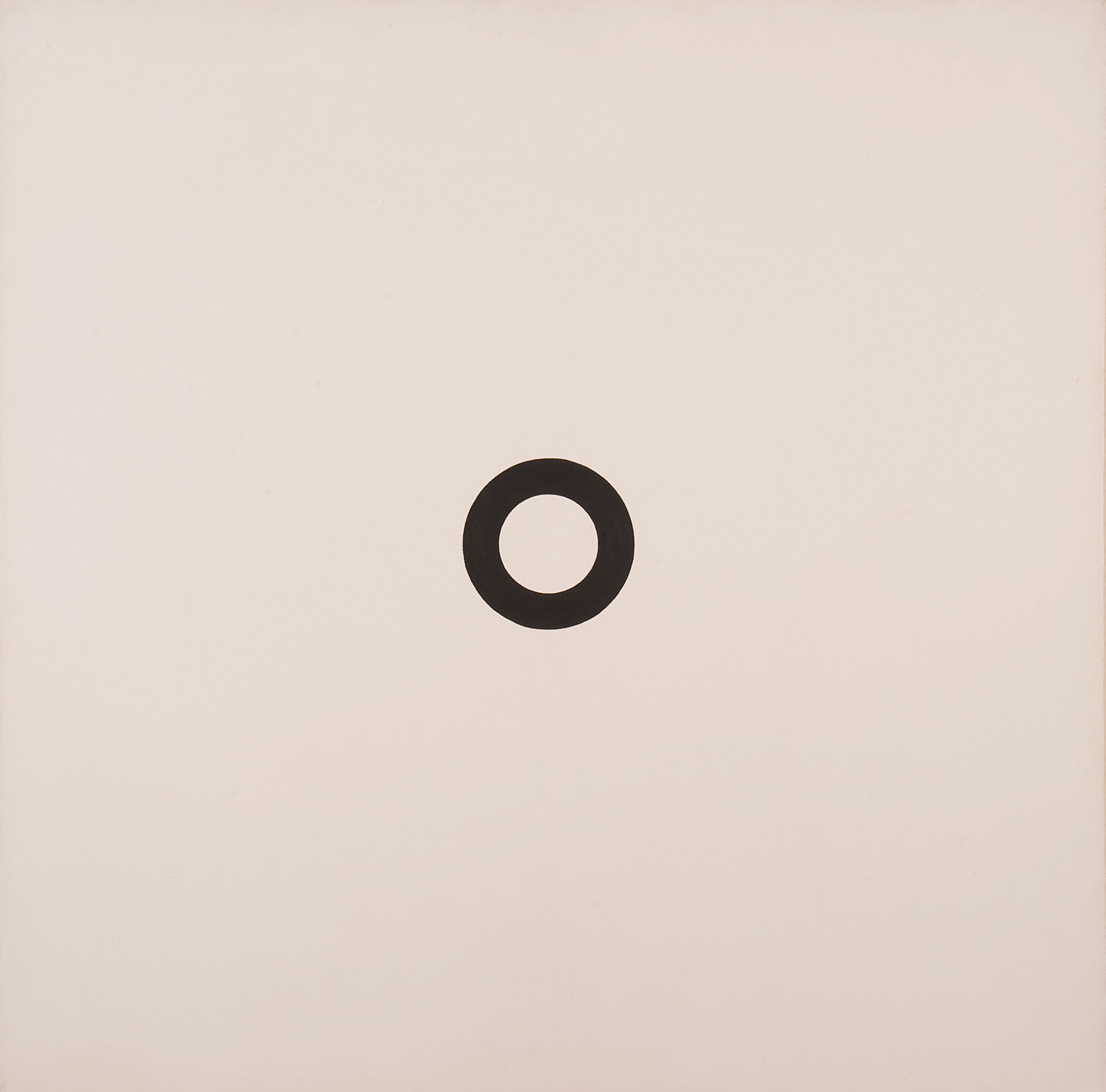
En 1965, il s’installe à Paris et débute son œuvre radicale : il peint la lettre A en noir sur une toile blanche de format carré, motif qui sera rapidement remplacé par un cercle noir qu’il répète jusqu’en 1974. En décembre 1966, il participe à la création du groupe B.M.P.T. Son art n’a pas pour vocation d’être une critique de la société ou d’avoir une dimension politique ; il se caractérise par l’annulation de toute expression de la peinture à travers un geste artistique mécanique
À partir de 1977, il peint des toiles monochromes, dans le but de « rendre visible le mécanisme dont la peinture procède » (Paul Elie Ivey). La même année, il s’installe aux Etats-Unis et continue son travail sur la monochromie. Dans les années 80, il revient à la peinture géométrique et à la bichromie.
Sans titre, 1970
Huile sur toile 100 x 100 cm Achat avec l’aide du FRAM, 1982
Inv. 982.6.143
L’œuvre d’Olivier Mosset représente un cercle noir de 15,5cm de diamètre et de 3,25 cm de large sur une toile carrée blanche.
La répétition et la multiplication de ce motifminimal permettent à l’artiste de se libérer de la contrainte de l’œuvre d’art unique. Cette démarche renvoie ainsi au caractère mécanique de l’acte de peindre, revendiqué par les artistes du mouvement BMPT. Pendant huit ans il a répété de façon automatique et insensible ce cercle, pour l’artiste, une bonne peinture doit être abstraite, pour éviter tout illusionnisme et contenu psychologique : « ce qui compte c’est faire de la peinture et que cette peinture fonctionne en tant que peinture ».
Oliver Mosset
Berne 1944
Olivier Mosset studied art in Lausanne and then became the assistant of Jean Tinguely and Daniel Spoerri in the early 1960s.
In 1965, he moved to Paris and began his radical work: he painted the letter A in black on a white square canvas, motif which was quickly replaced by a black circle that he repeated until 1974. In December 1966, he participates in the creation of the group B.M.P.T. His art is not intended to be a criticism of society or to have a political dimension; it is characterized by the cancellation of any expression of painting through an artistic gesture mechanical
From 1977, he paints canvases monochrome, with the aim of “making visible the mechanism from which painting proceeds” (Paul Elie Ivey). The same year, he moved to the United States and continued his work on monochromes. In the 1980s, he returned to geometric painting and two-color process.
Sans titre, 1970
Oil on canvas 100 x 100 cm Purchase with the help of FRAM, 1982
Inv. 982.6.143
Olivier Mosset’s work represents a black circle 15.5cm in diameter and 3.25cm wide on a white square canvas.
The repetition and the multiplication of this motifminimal allow the artist to free himself from the constraint of the single work of art. This approach thus refers to the mechanical character of the act of painting, claimed by the artists of the BMPT movement. For eight years he repeated automatically and insensitively this circle, for the artist, a good painting must be abstract, to avoid all illusionism and psychological content: “what counts is to make painting and that this painting functions as painting”.
Oliver Mosset
Berna 1944
Olivier Mosset ha studiato arte a Losanna e poi è diventato l’assistente di Jean Tinguely e Daniel Spoerri nei primi anni 60.
Nel 1965, si trasferisce a Parigi e inizia il suo lavoro radicale: dipinge la lettera A in nero su una tela quadrata bianca, motivo che viene rapidamente sostituita da un cerchio nero che ripete fino al 1974. Nel dicembre 1966, partecipa alla creazione del gruppo B.M.P.T. La sua arte non vuole essere una critica della società o avere una dimensione politica; è caratterizzata dalla cancellazione di qualsiasi espressione della pittura attraverso un gesto artistico meccanico.
A partire dal 1977, dipinge tele monocrome, con l’obiettivo di «rendere visibile il meccanismo da cui procede la pittura» (Paul Elie Ivey). Lo stesso anno, si trasferisce negli Stati Uniti e continua il suo lavoro sul monocromo. Negli anni ’80 torna alla pittura geometrica e al processo bicolore.
Sans titre, 1970
Olio su tela 100 x 100 cm Acquistato con l’aiuto del FRAM, 1982
Inv. 982.6.143
L’opera di Olivier Mosset rappresenta un cerchio nero di 15,5 cm di diametro e 3,25 cm di larghezza su una tela quadrata bianca.
La ripetizione e la moltiplicazione di questo motivominimo permettono all’artista di liberarsi dal vincolo della singola opera d’arte. Questo approccio si riferisce quindi al carattere meccanico dell’atto di dipingere, rivendicato dagli artisti del movimento BMPT. Per otto anni ha ripetuto automaticamente e insensibilmente questo cerchio, per l’artista, una buona pittura deve essere astratta, evitare ogni illusionismo e contenuto psicologico: «ciò che conta è fare pittura e che questa pittura funzioni come pittura».
Michel Parmentier
Paris 1938 – Paris 2000
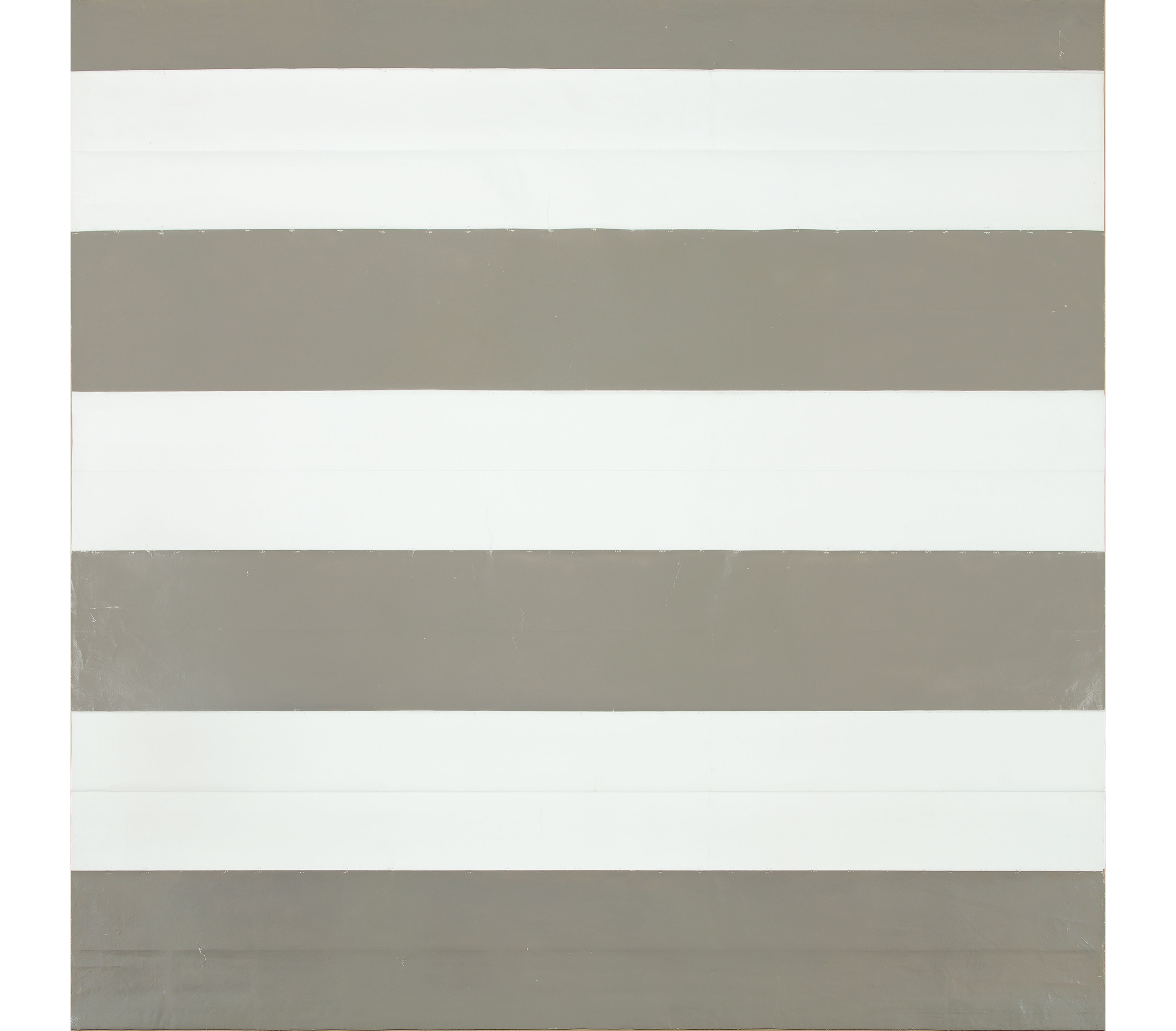
Michel Parmentier étudie à l’Ecole des Métiers d’Art (1957-1961), puis aux Beaux- Arts de Paris (1961-1963). Apres avoir fréquenté l’atelier de Roger Chastel avec Vincent Bioulès et Claude Viallat, il se rend dans celui de Simon Hantaï qui aura une influence déterminante sur son travail. Dès 1962, il participe au Salon de la Jeune Peinture en dénonçant l’Ecole de Paris et les mouvements artistiques du moment. En 1967, il se joint au groupe B.M.P.T. De 1968 à 1983, il cesse de peindre. Il reprend son activité artistique mais abandonne la couleur pour le dessin et le pliage qui est à la base de son travail. Il s’inspire de la technique de Simon Hantaï et créé ses toiles en peignant des bandes horizontales et en les pliant, laissant des surfaces non peintes, blanches. Technique mécanique, qui ne laisse aucune place au sensible, l’artiste recherche plus une distanciation vis-à-vis de l’œuvre qu’une dépersonnalisation.
Sans titre, 1967
Huile sur toile libre 245 x 230 cm Achat avec l’aide du FRAM, 1982
Inv. 982.6.80
Tout comme les autres membres du groupe BMPT, Michel Parmentier développe au début des années 1960 une méthode artistique dont le procédé de création suit un savoir-faire strict, permettant de rendre le geste du peintre répétitif et neutre.
C’est dans une lettre adressées en 1972 à François Mathey que Michel Parmentier parle ainsi de son travail : « J’ai peint, de 1965 à 1968, des bandes horizontales, de couleur unique de 38 cm de largeur, qui alternaient avec les bandes (de mêmes dimensions, blanches), de la toile protégée de la projection de peinture (bombe ou pistolet) par un pliage préalable, puis rendues apparentes par le dépliage. Ce travail fut strictement répété de 1965 à 1968, la couleur ne changeant arbitrairement d’une année sur l’autre que pour ne pas se charger d’une signification préférentielle ou symbolique. Cette description dit tout du produit-peinture dont je fus l’auteur. »
Michel Parmentier
Paris 1938 - Paris 2000
Michel Parmentier studied at the Ecole des Métiers d’Art (1957-1961), then at the Beaux- Arts de Paris (1961-1963). After attending Roger Chastel’sworkshop with Vincent Bioulès and Claude Viallat, he went to Simon Hantaï’s workshop which had a determining influence on his work. In 1962, he participated in the Salon de la Jeune Peinture, denouncing the Ecole de Paris (School of Paris) and the artistic movements of the time. In 1967, he joined the group B.M.P.T. From 1968 to 1983, he stopped painting. He resumed his artistic activity but abandoned color for drawing and folding which is the basis of his work. He is inspired by the technique of Simon Hantaï and creates his canvases by painting horizontal strips and folding them, leaving unpainted, white surfaces. A technique mechanical, that leaves no room for the sensitive, the artist seeks more a distancing from the work than a depersonalization.
Sans titre, 1967
Oil on canvas 245 x 230 cm Purchased with the help of the FRAM, 1982
Inv. 982.6.80
Like the other members of the BMPT, group, Michel Parmentier developed an artistic method in the early 1960s whose creative process followed a strict know-how, allowing the painter’s gesture to be repetitive and neutral.
In a 1972 letter to François Mathey, Michel Parmentier talks about his work as follows: “From 1965 to 1968, I painted horizontal strips of a single colour, 38 cm wide, which alternated with strips (of the same dimensions, white) of canvas protected from the spray of paint (spray or pistol) by a prior folding, then made visible by unfolding. This work was strictly repeated from 1965 to 1968, the colour changing arbitrarily from one year to the next only so as not to take on a preferential or symbolic meaning. This description says it all about the product-painting of which I was the author.”
Michel Parmentier
Parigi 1938 - Parigi 2000
Michel Parmentier ha studiato all’Ecole des Métiers d’Art (1957-1961), poi alle Beaux- Arts de Paris (1961-1963). Dopo aver frequentato lo studio di Roger Chastel con Vincent Bioulès e Claude Viallat, andò nello studio di Simon Hantaï, che ebbe un’influenza determinante sul suo lavoro. Nel 1962 partecipa al Salon de la Jeune Peinture, denunciando l’Ecole de Paris e i movimenti artistici dell’epoca. Nel 1967, si unisce al gruppo B.M.P.T. Dal 1968 al 1983, smette di dipingere. Riprende la sua attività artistica ma abbandona il colore per il disegno e la piegatura che è la base del suo lavoro. Si ispira alla tecnica di Simon Hantaï e crea le sue tele dipingendo strisce orizzontali e piegandole, lasciando le superfici bianche non dipinte. Una tecnica meccanica, che non lascia spazio al sensibile, l’artista cerca più un allontanamento dall’opera che una spersonalizzazione.
Sans titre, 1967
Olio su tela 245 x 230 cm Acquistato con l’aiuto del FRAM, 1982
Inv. 982.6.80
Come gli altri membri del gruppo BMPT, Michel Parmentier sviluppa all’inizio degli anni ’60 un metodo artistico il cui processo creativo segue un know-how rigoroso, permettendo al gesto del pittore di essere répétitif e neutrale.
È in una lettera indirizzata nel 1972 a François Mathey che Michel Parmentier parla così del suo lavoro: «Ho dipinto, dal 1965 al 1968, delle bande orizzontali, di colore unico di 38 cm di larghezza, che si alternavano alle bande (delle stesse dimensioni, bianche), della tela protetta dalla proiezione di vernice (spray o pistola) da una piegatura preliminare, resa poi evidente dallo dépliage. Questo lavoro è stato rigorosamente ripetuto dal 1965 al 1968, il colore cambiando arbitrariamente da un anno all’altro solo per evitare di assumere qualsiasi significato preferenziale o simbolico. Questa descrizione dice tutto sul prodotto-pittura di cui sono stato l’autore.»
Niele Toroni
Muralto 1937
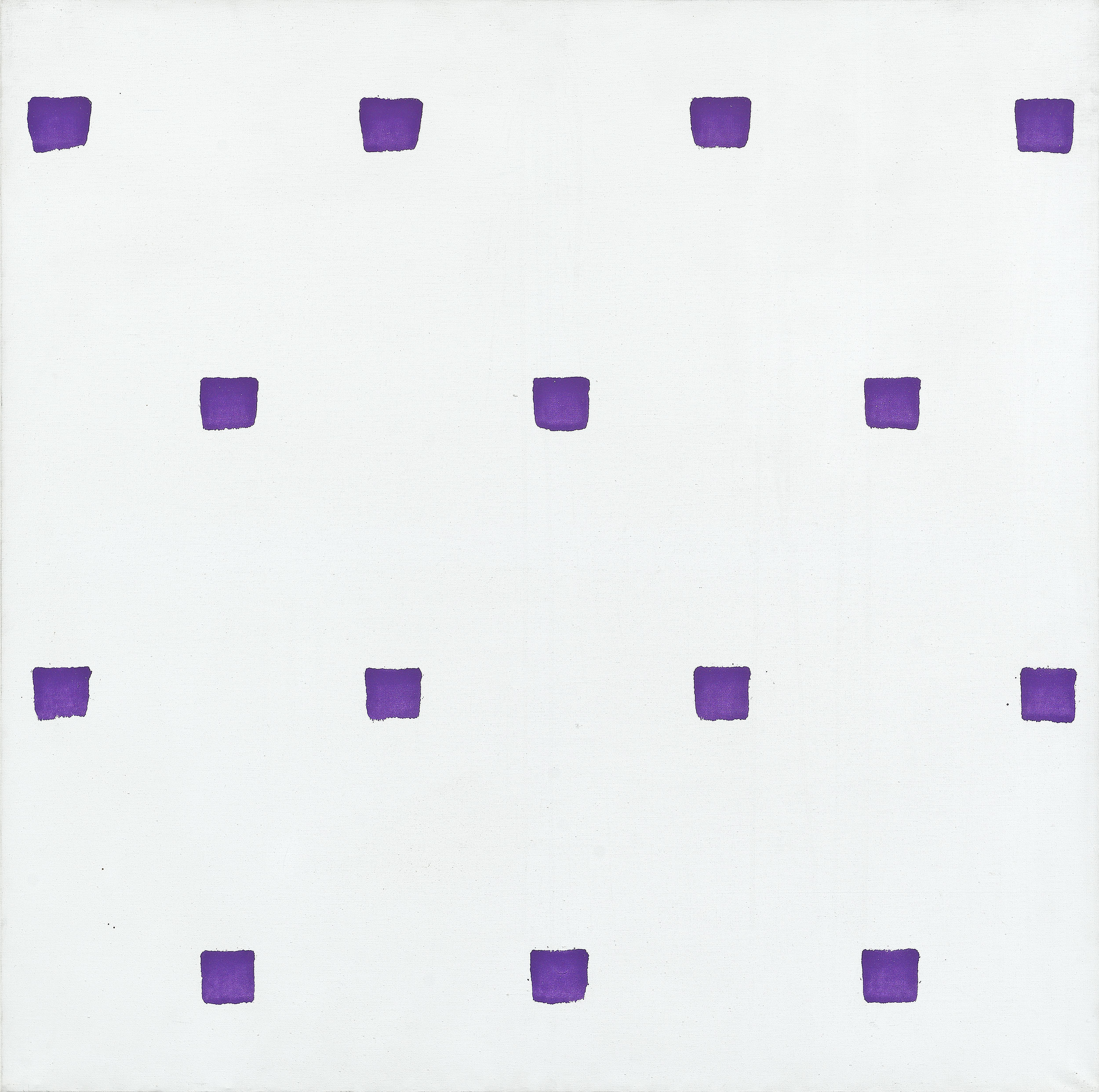
Niele Toroni s’installe à Paris en 1959. Après avoir pratiqué l’art abstrait, il met rapidement au point son vocabulaire pictural qui consiste à répéter des empreintes de pinceau n°50 espacées d’intervalles de trente centimètres. En 1967, il participe à la fondation du groupe B.M.P.T. A cette époque, ses empreintes sont peintes sur des toiles blanches tendues sur un châssis de format carré. Cette démarche répétitive limite l’artiste à un geste mécanique.
Depuis 1966, Niele Toroni ne cesse de décliner ce motif répétitif dans différentes couleurs et sur différents supports (toiles, murs, papiers, etc). Bien qu’il donne le même titre à toutes ses œuvres, Empreinte n°50répétées à intervalles réguliers (30 cm), son travail n’est jamais identique : les empreintes varient en fonction de la qualité de la peinture, du geste et du support.
Empreintes de pinceau n.50 répétées à intervalles réguliers (30 cm), 1973
Peinture glycérophtalique sur toile 100 x 100 cm Achat, 1980
Inv. 980.7.25
Comme l’indique le titre de l’œuvre, Niele Toroni réalise sur une toile blanche carrée des empreintes de pinceau n°50 répétées à intervalles réguliers de 30 cm. Elles sont monochromes et disposées en quinconce.
Son geste est minimal. Le motifabstrait formé par les poils du pinceau est proche du carré et se répète dans un rythme régulier. Toutefois, chaque empreinte possède sa particularité picturale due au hasard de l’application.
Depuis 1966, Niele Toroni continue d’appliquer ce processus formel dans ses œuvres. Que ce soit sur des toiles, des murs ou tout autre support, il fait des empreintes de pinceau n°50 et de la couleur son langage artistique.
Niele Toroni
Muralto 1937
Niele Toroni moved to Paris in 1959. After practicing abstract art, he quickly developed his pictorial vocabulary which consists of repeating prints of brush n°50 spaced at intervals of thirty centimeters. In 1967, he participates in the foundation of the group B.M.P.T. At this time, his prints are painted on white canvas stretched on a square frame. This repetitive approach limits the artist to a mechanical gesture.
Since 1966, Niele Toroni has not stopped using this repetitive motif in different colors and on different supports (canvas, walls, paper, etc.). Although he gives the same title to all his works, Empreinte n°50repeated at regular intervals (30 cm), his work is never identical: the prints vary according to the quality of the paint, the gesture and the support.
Empreintes de pinceau n.50 répétées à intervalles réguliers (30 cm), 1973
Glycerophtalic paint on canvas 100 x 100 cm Purchase, 1980
Inv. 980.7.25
As the title of the work indicates, Niele Toroni makes on a square white canvas prints of brush No. 50 repeated at regular intervals of 30 cm. They are monochrome and arranged in staggered rows.
His gesture is minimal The motifabstract formed by the bristles of the brush is close to the square and is repeated in a regular rhythm. However, each print has its own pictorial peculiarity due to the chance of application.
Since 1966, Niele Toroni has continued to apply this formal process in his works. Whether on canvas, walls or any other support, he has made the prints of brush n°50 and colour his artistic language.
Niele Toroni
Muralto 1937
Niele Toroni si è trasferito a Parigi nel 1959. Dopo aver praticato l’arte astratta, sviluppò rapidamente il suo vocabolario pittorico che consiste nella ripetizione di impronte di pennello n°50 a intervalli di trenta centimetri. Nel 1967 partecipa alla fondazione del gruppo B.M.P.T. A quel tempo, le sue stampe erano dipinte su tele bianche stese su un telaio quadrato. Questo approccio ripetitivo limita l’artista a un gesto meccanico.
Dal 1966, Niele Toroni ha continuato a utilizzare questo motivo ripetitivo in diversi colori e su diversi supporti (tela, muri, carta, ecc.). Anche se dà lo stesso titolo a tutte le sue opere, Empreinte n°50ripetute a intervalli regolari (30 cm), il suo lavoro non è mai identico: le stampe variano a seconda della qualità della pittura, del gesto e del supporto.
Empreintes de pinceau n.50 répétées à intervalles réguliers (30 cm), 1973
Vernice gliceroftalica su tela
100 x 100 cm
Acquisto, 1980
Inv. 980.7.25
Come indica il titolo dell’opera, Niele Toroni realizza su una tela bianca quadrata impronte di pennello #50 ripetute a intervalli regolari di 30 cm. Sono monocromatici e disposti in file sfalsate.
Il suo gesto è minimo Il motivoastratto formato dai peli della spazzola è vicino al quadrato e si ripete in un ritmo regolare. Tuttavia, ogni stampa ha la sua particolarità pittorica dovuta alla possibilità di applicazione.
Dal 1966, Niele Toroni ha continuato ad applicare questo processo formale nelle sue opere. Che sia su tela, muri o qualsiasi altro supporto, fa delle stampe del pennello n°50 e del colore il suo linguaggio artistico.