Dès 1967, de nombreuses expositions se multiplient, principalement autour de Nice, et réunissent des artistes qui partagent les mêmes théories sur la matérialité de la peinture. Ce n’est qu’en septembre 1970, lors d’une exposition à l’ARC de Paris, regroupant les artistes André-Pierre Arnal, Vincent Bioulès, Pierre Buraglio,Louis Cane, Marc Devade, Daniel Dezeuze, Noël Dolla,Toni Grand, Jean-Michel Meurice, Bernard Pagès, Jean-Pierre Pincemin,Patrick Saytour, André Valensi et Claude Viallat, que le groupe Supports/Surfaces est officiellement créé. Originaires du sud de la France pour la plupart, ils se définissent comme non figuratifs et se rassemblent avec la même volonté de questionner la peinture et le tableau. Leurs recherches s’orientent vers la déconstruction du tableau basée sur le détournement des fonctions de support et de surface : châssis peint, châssis qui devient œuvre (Dezeuze), montant de fenêtres (Buraglio),toile libre (Viallat, Dolla), toile exposée au sol, etc. Les techniques et les pratiques sont variées et propres à chacun.
Suite à des divergences artistiques et politiques, le groupe Supports/Surfaces commence à se dissoudre en 1971. La même année est créée la revue Peinture – Cahiers théoriques. En 1973-1974, les expositions individuelles des membres du groupe se multiplient, marquant ainsi la fin de Supports/Surfaces.
From 1967, numerous exhibitions multiplied, mainly around Nice, and brought together artists who shared the same theories on the materiality of painting. It was not until September 1970, during an exhibition at the ARC in Paris, bringing together artists André-Pierre Arnal, Vincent Bioulès, Pierre Buraglio, Louis Cane, Marc Devade, Daniel Dezeuze, Noël Dolla, Toni Grand, Jean-Michel Meurice, Bernard Pagès, Jean-Pierre Pincemin,Patrick Saytour, André Valensi and Claude Viallat, that the group Supports/Surfaces is officially created. Most of them were from the south of France and defined themselves as non-figurative, coming together with the same desire to question painting and the frame. Their research is oriented towards the deconstruction of the frame based on the detournation of the functions of support and surface : frame painted, frame which becomes a work (Dezeuze), window mount (Buraglio),canvas free (Viallat, Dolla), canvas exposed on the ground, etc. The techniques and the practices are varied and specific to each one.
Following artistic and political divergences, the group Supports/Surfaces began to dissolve in 1971. The same year, the journal Peinture - Cahiers théoriques was created. In 1973-1974, individual exhibitions by members of the group multiplied, marking the end of Supports/Surfaces.
A partire dal 1967, si tennero numerose mostre, soprattutto nei dintorni di Nizza, che riunirono artisti che condividevano le stesse teorie sulla materialità della pittura. Solo nel settembre 1970, durante una mostra all’ARC di Parigi, gli artisti André-Pierre Arnal, Vincent Bioulès, Pierre Buraglio, Louis Cane, Marc Devade, Daniel Dezeuze, Noël Dolla, Toni Grand, Jean-Michel Meurice, Bernard Pagès, Jean-Pierre Pincemin, Patrick Saytour, André Valensi e Claude Viallat, che il gruppo Supports/Surfaces è ufficialmente creato. Per lo più provenienti dal sud della Francia, si definivano non-figurativi e si riunivano con lo stesso desiderio di mettere in discussione la pittura e il tavola. La loro ricerca è orientata verso la decostruzione del tavola basata sul déturbo delle funzioni di supporto e superficie : frame dipinto, frame che diventa un’opera (Dezeuze), montaggio della finestra (Buraglio),tela libero (Viallat, Dolla)tela esposto sul pavimento, ecc. Le tecniche e le pratiche sono varie e specifiche per ciascuno.
In seguito a divergenze artistiche e politiche, il gruppo Supports/Surfaces cominciò a sciogliersi nel 1971. Lo stesso anno fu creata la rivista Peinture - Cahiers théoriques. Nel 1973-1974, le mostre individuali dei membri del gruppo si moltiplicano, segnando la fine di Supports/Surfaces.
Est abstraite, ou non figurative, une œuvre qui ne représente pas de sujet reconnaissable. L’art abstrait est une tendance artistique qui apparaît au début du XXe siècle.
Abstract, or non-figurative, art is art that does not represent a recognisable subject. Abstract art is an artistic trend that appears at the beginning of the 20th century.
L’arte astratta, o non figurativa, è l’arte che non rappresenta un soggetto riconoscibile. L’arte astratta è una tendenza artistica che appare all’inizio del XX secolo.
AGRAFAGESTAPLINGPINZATURA
Action d’attacher ou fixer du papier, du tissu à quelque chose au moyen d’agrafes et d’une agrafeuse.
The act of attaching or fixing paper or fabric to something by means of staples and a stapler.
L’atto di attaccare o fissare carta o tessuto a qualcosa per mezzo di punti metallici e di una cucitrice.
CHASSISFRAMETELAIO
Cadre destiné à maintenir en place des planches, des vitres, du tissu, ou papier. En peinture, le terme désigne la structure en bois sur laquelle la toile est tendue.
A frame designed to hold boards, glass, cloth or paper in place. In painting, the term refers to the wooden structure on which the canvas is stretched.
Una cornice per tenere in posizione tavole, vetro, tela o carta. In pittura, il termine si riferisce alla struttura di legno su cui la tela è tesa.
DÉCONSTRUCTIONDECONSTRUCTIONDECOSTRUZIONE
Démontage sélectif de certains éléments d’une construction, parfois dans le but de valoriser les déchets.
Selective dismantling of certain elements of a construction, sometimes with the aim of recovering the waste.
Smantellamento selettivo di alcuni elementi di una costruzione, a volte con lo scopo di recuperare i rifiuti.
DÉGRADÉ
DEGRADEDDEGRADATO
Se dit d’une couleur que l’on affaiblit de manière progressive.
Said of a colour that is gradually faded.
Detto di un colore che è gradualmente sbiadito.
DÉPIAUTAGEDEPLETIONDEPLEZIONE
Retirer minutieusement ce qui couvre ou maintient quelque chose, dépouiller de son enveloppe.
To meticulously remove what covers or holds something, to strip it of its envelope.
Rimuovere meticolosamente ciò che copre o tiene insieme qualcosa, spogliarlo del suo guscio.
DÉTOURNEMENTDETOURNATIONDETURBO
Acte de réutiliser un matériau préexistant au profit d’une nouvelle signification.
The act of reusing a pre-existing material for the sake of a new meaning.
Atto di riutilizzare un materiale preesistente per ottenere un nuovo significato.
EMPREINTEEMPREINTEEMPREINTE
Trace laissée par quelque chose ou quelqu’un, sous l’action de son poids, de son déplacement ou de son frottage.
Trace left by something or someone, under the action of its weight, its displacement or its rubbing.
Traccia lasciata da qualcosa o qualcuno, sotto l’azione del suo peso, del suo spostamento o del suo sfregamento.
ÉQUARRIEQUARRIEQUARRI
Bois taillé de façon a le rendre carré, à angles droits.
Wood cut to make it square, with right angles.
Legno tagliato per renderlo quadrato, con angoli retti.
FIGURATIONFIGURATIONFIGURA
En art, la figuration est l’action de représenter quelque chose issu du réel ou de l’imaginaire de manière reconnaissable, par des moyens graphiques. L’art figuratif s’oppose à l’Art abstrait qui ne représente pas le monde visible, sensible (réel ou imaginaire) ; qui utilise la matière, la ligne, les formes, la couleur pour elles-mêmes.
In art, figuration is the act of representing something from the real or imaginary in a recognisable way, by graphic means. Figurative art is opposed to Abstract art, which does not represent the visible, sensitive world (real or imaginary) ; which uses matter, line, shapes, colour for their own sake.
Nell’arte, la figurazione è l’azione di rappresentare qualcosa del reale o dell’immaginario in modo riconoscibile, con mezzi grafici. L’arte figurativa si oppone all’arte astratta, che non rappresenta il mondo visibile e sensibile (reale o immaginario) ; che usa la materia, la linea, le forme, il colore per se stessi.
JUXTAPOSITIONJUXTAPOSITIONJUXTAPOSITION
Action de poser côte à côte, sans liaison.
Action of laying side by side, without connection.
L’atto di giacere fianco a fianco, senza connessione.
MATÉRIAUMATERIALMATERIALE
Ce qui constitue ou est destiné à constituer une œuvre.
What constitutes or is intended to constitute a work.
Ciò che costituisce o è destinato a costituire un’opera.
MINIMALMINIMALMINIMO
Qui atteint sa plus petite valeur, son plus bas degré, son minimum.
L’Art Minimal ou Minimalisme est un courant de l’art contemporain né dans les années 1960 aux Etats-Unis, dans lequel l’intervention de l’artiste est réduite à son minimum, l’œuvre réduite à des formes d’une extrême simplification géométrique, ainsi qu’à des modalités élémentaires de matière ou de couleur.
Which reaches its lowest value, its lowest degree, its minimum.
Minimal Art or Minimalism is a current of contemporary art born in the 1960s in the United States, in which the artist’s intervention is reduced to its minimum, the work reduced to forms of extreme geometric simplification, as well as to elementary modalities of material or colour.
Ciò che raggiunge il suo valore più basso, il suo grado più basso, il suo minimo.
La Minimal Arte o Minimalismo è una corrente dell’arte contemporanea nata negli anni 1960 negli Stati Uniti, in cui l’intervento dell’artista è ridotto al minimo, l’opera ridotta a forme di estrema semplificazione geometrica, così come a modalità elementari di materia o colore.
MONOCHROMEMONOCHROMEMONOCROMO
Signifie qui est d’une seule couleur. Artistiquement, un monochrome désigne également un type d’œuvres : toile ou autre surface recouverte entièrement d’une même couleur par un artiste.
Means that is of one colour only. Artistically, a monochrome also refers to a type of work : canvas or other surface covered entirely with one colour by an artist.
Significa che è di un solo colore. Artisticamente, un monocromo si riferisce anche a un tipo di opera : tela o altra superficie coperta interamente con un solo colore da un artista.
MOTIFMOTIFMOTIF
Sujet qui domine une œuvre d’art, un ouvrage. Dessin, ornement, le plus souvent répété, sur un support quelconque, par exemple un tissu à motifs floraux. Dessiner/peindre sur le motif est également un terme employé pour qualifier l’action de dessiner/dessiner directement devant le paysage que l’on souhaite représenter.
The subject that dominates a work of art. A drawing, an ornament, usually repeated, on some kind of support, e.g. a fabric with floral motifs. Drawing/painting on the motif is also a term used to describe the action of drawing/drawing directly in front of the landscape one wishes to represent.
Soggetto che domina un’opera d’arte, un’opera. Disegno, ornamento, per lo più ripetuto, su qualche supporto, per esempio, tessuto a motivi floreali. Disegnare/dipingere sul modello è anche un termine usato per descrivere l’azione di disegnare/disegnare direttamente davanti al paesaggio che si vuole rappresentare.
PEINTUREPAINTINGPITTURA
Matière colorante composée d’un pigment et d’un liant, utilisée pour recouvrir une surface, pour la protéger ou l’orner. Elle peut désigner également l’art de peindre dont se sont saisi de nombreux mouvements artistiques, les réalisations des artistes peintres et l’œuvre elle-même (tableau, fresque…) faite de couleurs étalées sur une surface.
A colouring material composed of a pigment and a binder, used to cover a surface, to protect it or to decorate it. It can also refer to the art of painting, which has been taken up by many artistic movements, the achievements of painters and the work itself (painting, fresco, etc.) made of colours spread on a surface.
Una materia colorante composta da un pigmento e un legante, usata per coprire una superficie, per proteggerla o per adornarla. Può anche riferirsi all’arte della pittura, che è stata ripresa da molti movimenti artistici, alle realizzazioni dei pittori e all’opera stessa (pittura, affresco, ecc.) fatta di colori stesi su una superficie.
PICTURALPICTURALPICTURAL
Qui a un rapport ou appartient à la peinture.
A material that is related to or belongs to painting.
Ciò che riguarda o appartiene alla pittura.
RÉPÉTITIONREPETITIONRIPETIZIONE
Action de reproduire plusieurs fois.
The act of reproducing several times.
Azione di riprodursi più volte.
SCULPTURESCULPTURESCULTURA
Ensemble des techniques qui permettent la représentation d’un objet dans l’espace au moyen d’une matière à laquelle on impose une forme esthétique.
All the techniques that allow the representation of an object in space by means of a material on which an aesthetic form is imposed.
Tutte le tecniche che permettono la rappresentazione di un oggetto nello spazio per mezzo di un materiale al quale viene imposta una forma estetica.
STRATIFIÉ
STRATIFIEDSTRATIFICATO
Se dit d’un matériau constitué de couches, lamelles de bois, fibre de verre imprégnées de résines.
A material made up of layers, wood strips, fibreglass impregnated with resins.
Detto di un materiale composto da strati, strisce di legno, fibra di vetro impregnati di resine.
Le support est un élément qui sert de base à une œuvre graphique. La surface est la partie extérieure d’un corps ou d’un objet. Supports/Surfaces est un mouvement artistique apparu en France à la fin des années 1960. Les membres de ce groupe fondateur de l’art contemporain français, se retrouvent, que ce soit par la peinture ou la sculpture, dans le questionnement du tableau, dans la pratique de la peinture qui interroge ses composants élémentaires : cadre, toile, châssis, tissus, peinture etc…
The substrate is an element that serves as a basis for a graphic work. The surface is the outer part of a body or object. The Supports/Surfaces is an artistic movement that emerged in France in the late 1960s. The members of this founding group of French contemporary art find themselves, whether through painting or sculpture, in the questioning of the painting, in the practice of painting which questions its elementary components : frame, canvas, stretcher, fabric, paint etc...
Il substrato è un elemento che serve come base per un lavoro grafico. La superficie è la parte esterna di un corpo o di un oggetto. Il Supports/Surfaces è un movimento artistico apparso in Francia alla fine degli anni ’60. I membri di questo gruppo fondatore dell’arte contemporanea francese, si ritrovano, sia attraverso la pittura che la scultura, nella messa in discussione della pittura, nella pratica della pittura che mette in discussione le sue componenti elementari : telaio, tela, telaio, tessuto, pittura ecc.
TABLEAUTABLETAVOLA
Peinture exécutée sur un support préparé à cet effet (panneau de bois ou d’autres matériaux, ou toile tendue sur un châssis).
Painting executed on a support prepared for the purpose (panel of wood or other materials, or canvas stretched on a frame).
Pittura eseguita su un supporto preparato allo scopo (pannello di legno o altri materiali, o tela tesa su un telaio).
TOILECANVASCANVAS
Tissu de lin, de chanvre, de coton qui peut être tendu pour être peint.
A fabric of linen, hemp or cotton that can be stretched for painting.
Un tessuto di lino, canapa, cotone che può essere stirato per la pittura.
Pierre Buraglio
Charenton 1939
Pierre Buraglio intègre à l’âge de vingt ans les Beaux-Arts de Paris. Il fréquente l’atelier de Roger Chastel où il côtoie Bioulès, Viallat et Parmentier. En 1964, après un séjour à New-York, il élabore ses premiers Recouvrements puis commence ses premiers Agrafages en 1966. Entre 1969 et 1973, il cesse de peindre pour se consacrer à une activité politique militante. Un an plus tard, il se recentre sur sa pratique artistique et travaille sur les Châssis et les Cadres. L’année 1976 est marquée par sa première exposition personnelle au Musée d’art Moderne de Paris et par ses premières Fenêtres. Depuis, il expose régulièrement en France (Musée d’Art de Toulon, 2006) et à l’étranger.
Pierre Buraglio n’a jamais adhéré au mouvement Supports/Surfaces. Il a fréquenté et partagé les mêmes recherches plastiques que les membres du groupe, mais sans suivre leurs idées théoriques.
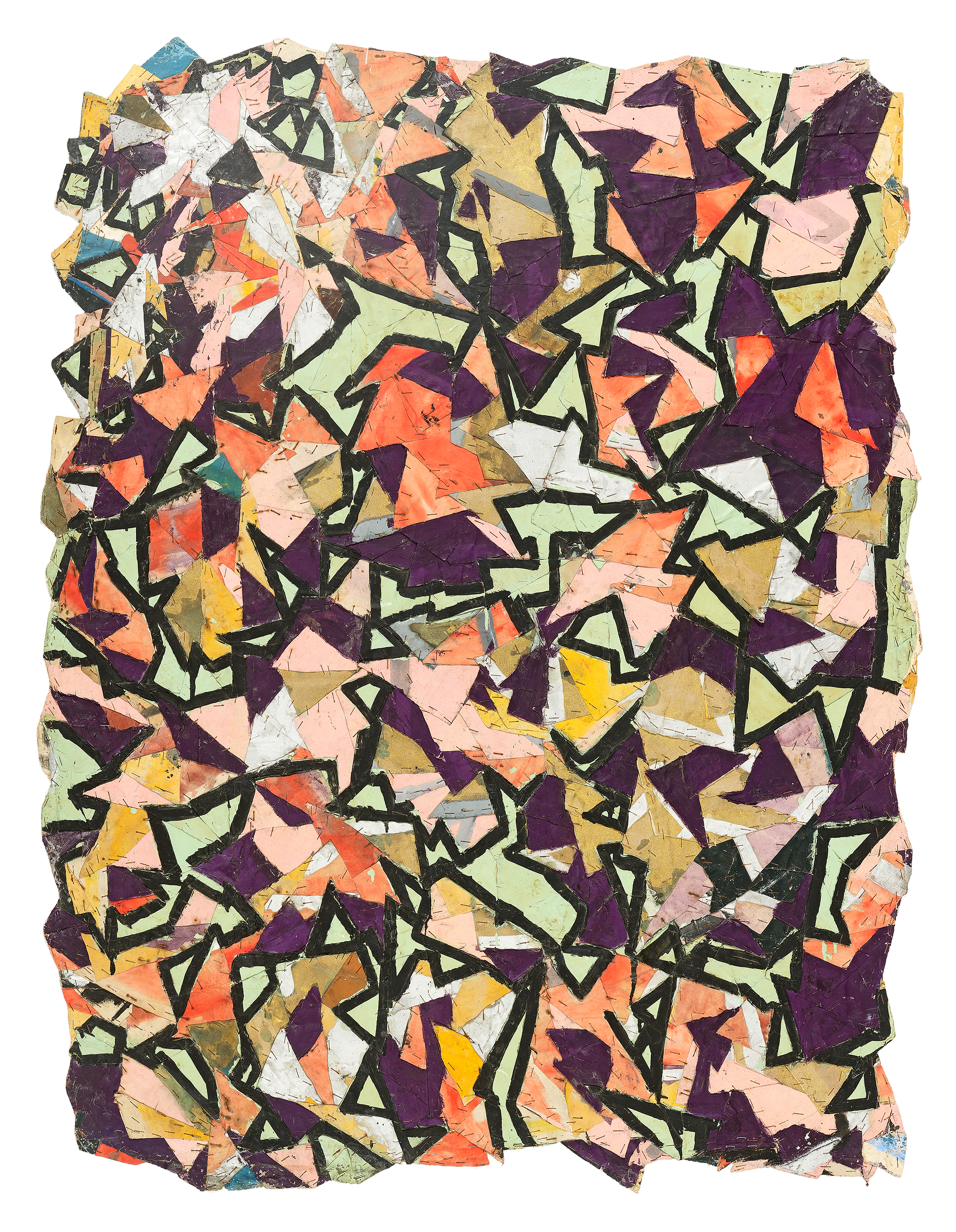
Agrafages, 1966
Chutes de toiles peintes et agrafées 145 x 110 cm Achat avec l’aide du FRAM, 1982
Inv. 982.6.251
Cette œuvre de Pierre Buraglio montre l’intérêt de l’artiste pour le principe du recyclage.
Les chutes de toiles, provenant de tableaux récupérés, sont découpées en triangles irréguliers, assemblées par interpénétration et juxtaposition puis ensuite agrafées entre elles, au hasard et de manière mécanique.
L’ensemble est laissé flottant, sans châssis. Les agrafages permettent à l’artiste de déconstruire le tableau traditionnel pour proposer une nouvelle composition picturale abstraite, très colorée et dynamique.
On retrouve par la suite cette même logique de treillage dans les Camouflages créés par l’artiste dans les années 1966-1968.
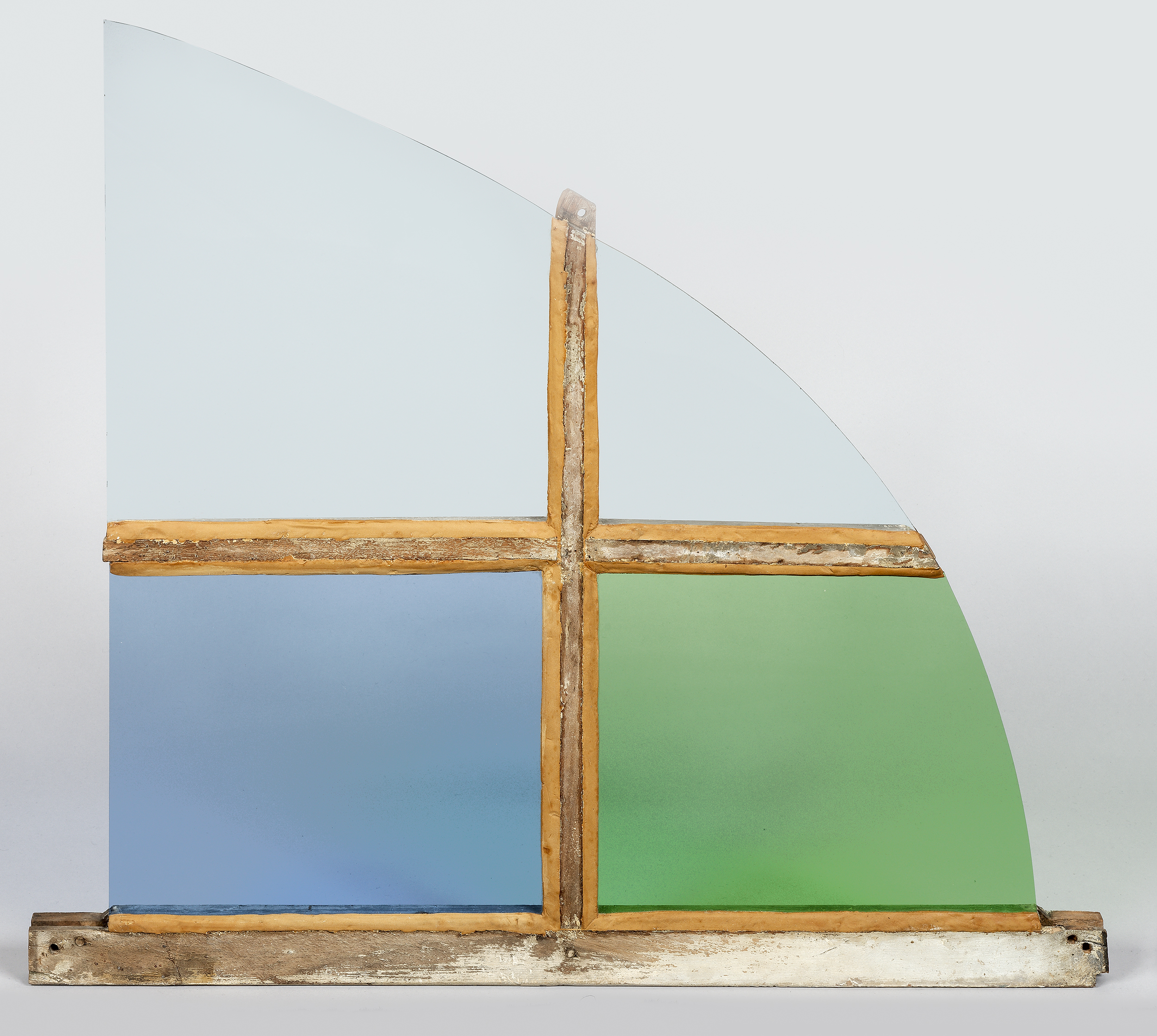
Fenêtre, 1982
Verre étiré bleu, vert, vitre et bois 70 x 80 cm Achat avec l’aide du FRAM, 1982
Inv. 982.6.250
Durant les années 1970, Pierre Buraglio développe de nombreux procédés picturaux dont la série des Fenêtres fait partie. Il utilise alors de véritables fenêtres trouvées et récupérées sur des chantiers, parfois sans les modifier ou en les retravaillant à la manière d’un artisan.
Les vitres transparentes sont ici remplacées par des verres de couleurs bleue et verte conférant au matériau une charge picturale sans utiliser de peinture.
La fenêtre est détournée de son utilité première, elle n’ouvre sur rien mis à part le mur qui la soutient, y projetant son ombre, laissée à l’appréciation et à l’imaginaire des visiteurs. Le contraste entre enfermement et évasion crée ici toute la dynamique de l’œuvre.
Fidèle à sa première volonté de ne rien montrer : Pierre Buraglio préfère, comme bien souvent, « présenter » le réel plutôt que le « représenter ».
Pierre Buraglio
Charenton 1939
Pierre Buraglio entered the Beaux-Arts de Paris at the age of twenty. He attended the studio of Roger Chastel where he rubbed shoulders with Bioulès, Viallat and Parmentier. In 1964, after a stay in New York, he worked on his first Recoveries and then began his first Agrafages(stapling) in 1966. Between 1969 and 1973, he stopped painting to devote himself to political activism. A year later, he refocuses on his artistic practice and works on the Châssis(frame) and Cadres. The year 1976 was marked by his first solo exhibition at the Museum of Modern Art in Paris and by his first Windows. Since then, he has exhibited regularly in France (Musée d’Art de Toulon, 2006) and abroad.
Pierre Buraglio has never adhered to the movement Supports/Surfaces. He frequented and shared the same plastic research as the members of the group, but without following their theoretical ideas.
Agrafages, 1966
Painted and stapled canvas scraps 145 x 110 cm Purchased with the help of the FRAM, 1982
Inv. 982.6.251
This work by Buraglio shows the artist’s interest in the principle of recycling.
Scraps of canvases, from salvaged paintings, are cut into irregular triangles, assembled by interpenetration and juxtaposition and then stapled together, randomly and mechanically.
The whole is left floating, without a frame. The stapling allows the artist to deconstruct the traditional painting to propose a new abstract pictorial composition, very colourful and dynamic.
This same logic of latticework can be found in the Camouflages created by the artist in the years 66-68.
Fenêtre, 1982
Blue and green stretched glass, glass and wood 70 x 80 cm Purchased with the help of FRAM, 1982
Inv. 982.6.250
During the 1970s, Buraglio developed numerous pictorial processes, of which the Window series is one. He then used real windows found and recovered on building sites, sometimes without modifying them or reworking them in the manner of a craftsman.
The transparent panes are replaced here by blue and green glass, giving the material a pictorial charge without using paint.
The window is diverted from its primary use, it opens onto nothing but the wall that supports it, casting its shadow, left to the appreciation and imagination of visitors. The contrast between confinement and escape creates the whole dynamic of the work.
Faithful to his first desire to show nothing, Buraglio prefers, as he often does, to “present” reality rather than “represent” it.
Pierre Buraglio
Charenton 1939
Pierre Buraglio è entrato alle Beaux-Arts di Parigi all’età di vent’anni. Frequenta lo studio di Roger Chastel, dove frequenta Bioulès, Viallat e Parmentier. Nel 1964, dopo un soggiorno a New York, lavora ai suoi primi Recoveries e poi inizia i suoi primi Agrafages nel 1966. Tra il 1969 e il 1973, smise di dipingere per dedicarsi a un’attività politica militante. Un anno dopo, si concentra sulla sua pratica artistica e lavora al Châssis e Cadres. L’anno 1976 fu segnato dalla sua prima mostra personale al Museo d’Arte Moderna di Parigi e dal suo primo Windows. Da allora, espone regolarmente in Francia (Musée d’Art de Toulon, 2006) e all’estero.
Buraglio non ha mai aderito al movimento Supports/Surfaces. Frequentava e condivideva le stesse ricerche plastiche dei membri del gruppo, ma senza seguire le loro idee teoriche.
Agrafages, 1966
Ritagli di tela dipinti e pinzati 145 x 110 cm Acquistato con l’aiuto del FRAM, 1982
Inv. 982.6.251
Quest’opera di Buraglio mostra l’interesse dell’artista per il principio del riciclaggio.
Ritagli di tela, provenienti da quadri di recupero, sono tagliati in triangoli irregolari, assemblati per compenetrazione e giustapposizione e poi pinzati insieme, in modo casuale e meccanico.
Il tutto è lasciato fluttuare, senza una cornice. La pinzatura permette all’artista di decostruire la pittura tradizionale per proporre una nuova composizione pittorica astratta, molto colorata e dinamica.
Questa stessa logica del reticolo si ritrova nei Camouflages creati dall’artista negli anni 66-68.
Fenêtre, 1982
Vetro teso blu e verde, vetro e legno 70 x 80 cm Acquistato con l’aiuto del FRAM, 1982
Inv. 982.6.250
Durante gli anni ’70, Buraglio sviluppò numerosi processi pittorici, di cui la serie Window è uno. Ha poi utilizzato delle vere finestre trovate e recuperate nei cantieri, a volte senza modificarle o rielaborarle alla maniera di un artigiano.
I vetri trasparenti sono sostituiti qui da vetri blu e verdi, dando al materiale una carica pittorica senza usare la vernice.
La finestra è deviata dal suo uso primario, si apre su nient’altro che il muro che la sostiene, proiettando la sua ombra, lasciata all’apprezzamento e all’immaginazione dei visitatori. Il contrasto tra la reclusione e la fuga crea l’intera dinamica dell’opera.
Fedele al suo primo desiderio di non mostrare nulla, Buraglio preferisce, come spesso fa, «presentare» la realtà piuttosto che «rappresentarla».
Vincent Bioulès
Montpellier 1938
Vincent Bioules se forme à l’école des beaux-arts de Montpellier, puis aux Beaux Arts de Paris où il rencontre Michel Parmentier et Pierre Buraglio. En 1970, il rejoint Claude Viallat et Daniel Dezeuze, ses anciens amis étudiants des beaux-arts de Montpellier, au sein du mouvement Supports/Surfaces dont il se trouve être également l’inventeur de la dénomination. Bioulès peint des couleurs en aplat à l’aide de ruban adhésif selon des plans géométriques simples.
Après avoir quitté le groupe Supports/Surfaces en 1972, il réalise des toiles représentant des fenêtres. Un thème qui lui permet de revenir de manière naturelle et officielle à la peinture figurative. Les paysages et portraits qu’il compose désormais rendent fréquemment hommage à Matisse et Cézanne et magnifient les paysages du sud de la France qu’il a l’habitude de côtoyer.
Le Musée d’Art de Toulon lui consacre une exposition en 1995 : Vincent Bioulès, parcours 1965 – 1995.
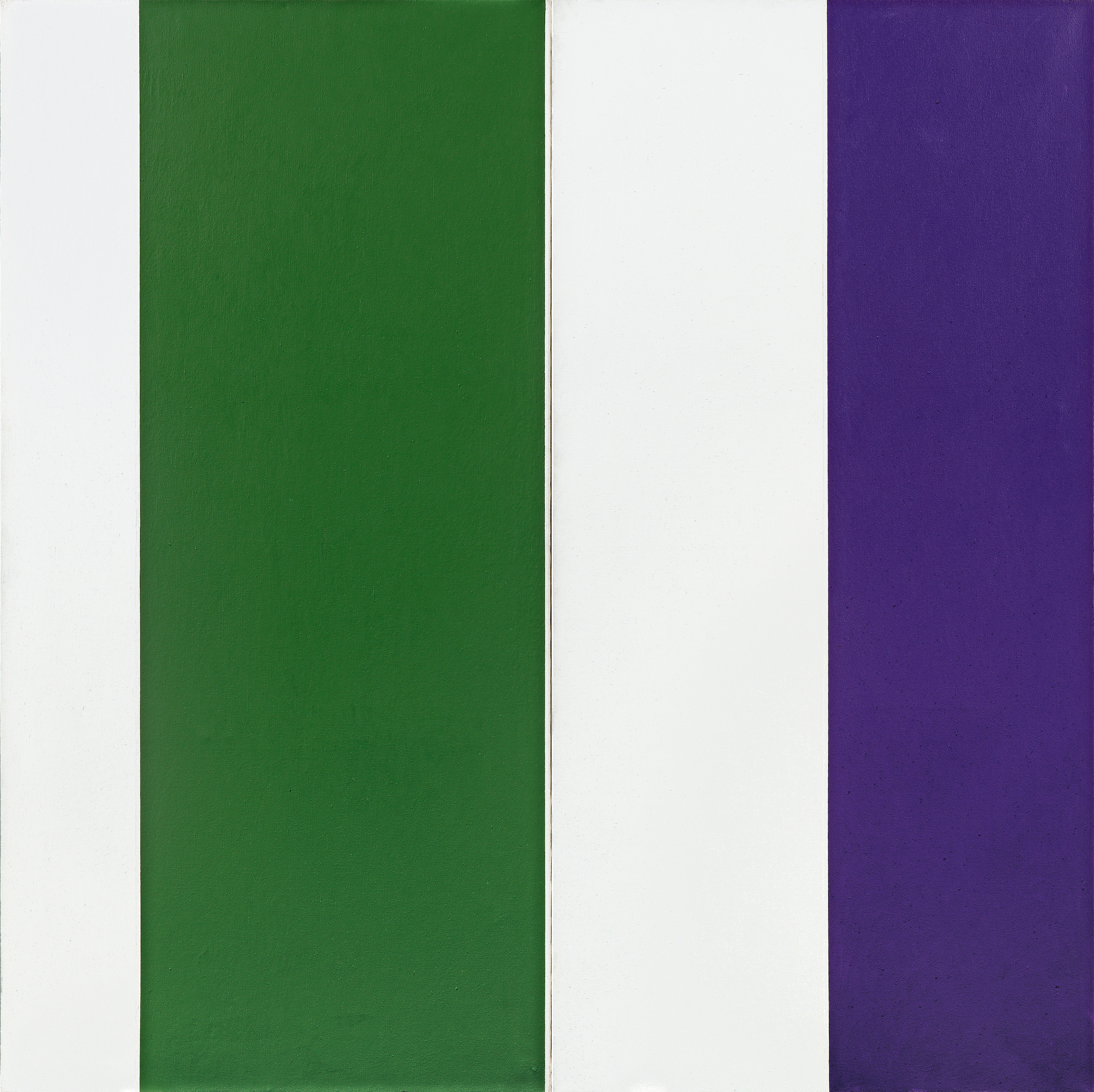
Peinture, 1970
Diptyque Acrylique sur toile 195 x 194 cm Don Bioulès, 1995
Inv. 996.5.16.1-2
De 1970 à 1971 Vincent Bioules fait partie du mouvement Supports/Surfaces. Pendant cette période l’artiste pratique une peinture brute et nue dans un dépouillement radical.
Dans cette toile, la peinture est montrée pour ce qu’elle est, une surface de couleur industrielle, sans trace et sans expressivité.
Pour organiser l’espace de la toile et délimiter les plans colorés, Vincent Bioules utilise le ruban adhésif, permettant d’aboutir à un résultat géométrique net et équilibré.
Bien qu’étant à l’origine du mouvement Supports/Surfaces, Vincent Bioules ne participe que brièvement à l’aventure et revient après 1971 à la figuration, pratique qu’il n’a jamais vraiment délaissée.
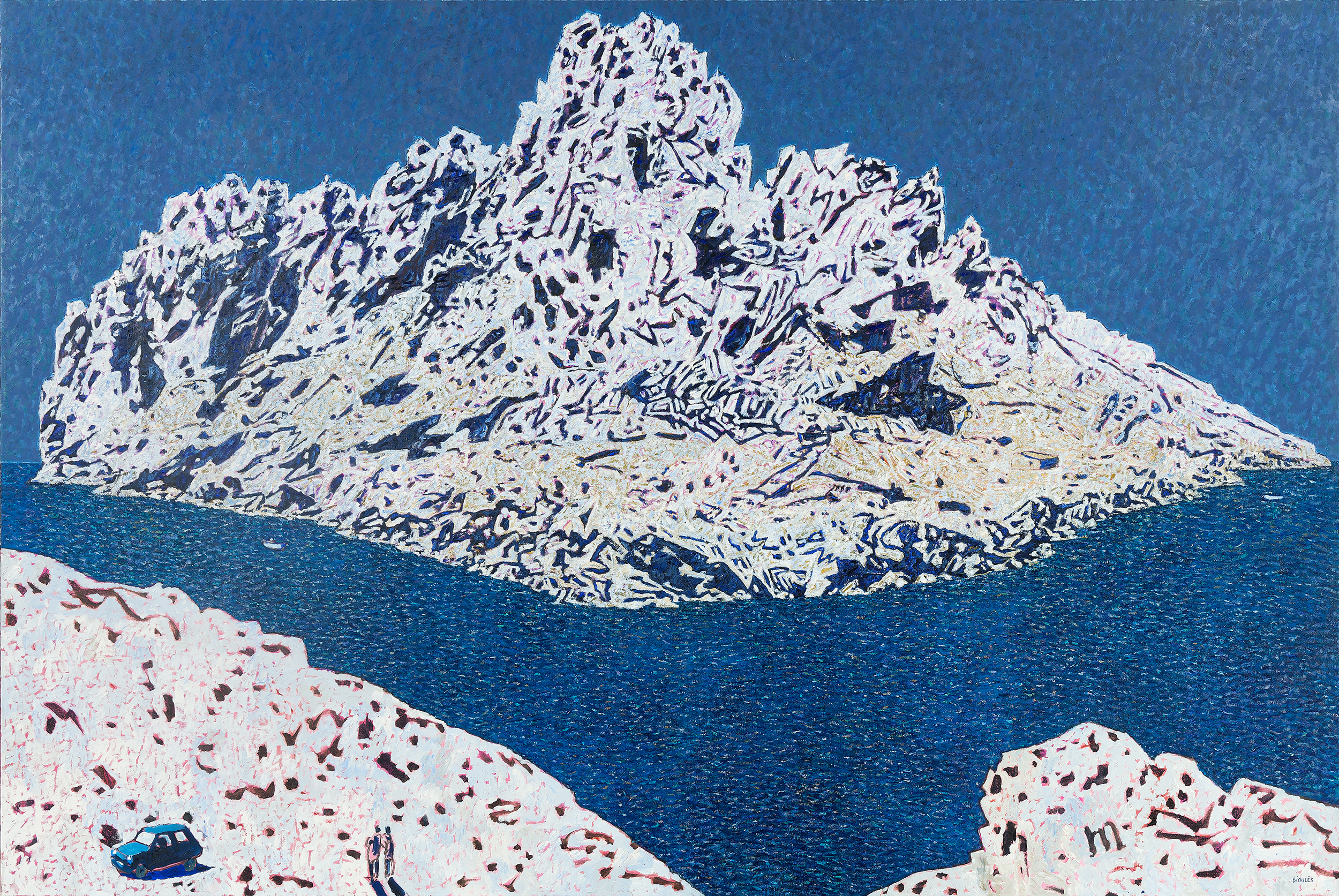
L’île Maire I, 1994-1995
Huile sur toile 200 x 300,5 cm Don de l’Association pour les musées de Toulon, 1995
Inv. 996.5.15
La couleur est pour Vincent Bioules l’émanation de la lumière et des sentiments. En 1972, l’abstraction ne lui permettant pas d’exprimer sa sensibilité, l’artiste se tourne vers la figuration avec les thèmes matissiens de la fenêtre et de l’atelier. Plus tard, c’est dans le sud de la France que Bioules expérimente le paysage, sujet essentiel dans sa pratique artistique.
En 1995, à la suite de plusieurs séjours dans l’atelier de la villa Bianco (Marseille), il présente des toiles de grand format tel que L’île Maïre II, île située au sud ouest de Marseille. La palette chromatique est réduite et très contrastée, contribuant aussi à l’impression d’immensité du paysage.
Vincent Bioules se situe au-delà du clivage de l’asbraction et de la figuration pour se questionner sur le sujet essentiel qu’est la peinture.
Vincent Bioulès
Montpellier 1938
Vincent Bioules studied at the Montpellier School of Fine Arts, then at the Beaux Arts de Paris where he met Michel Parmentier and Pierre Buraglio. In 1970, he joined Claude Viallat and Daniel Dezeuze, his former friends from the Montpellier School of Fine Arts, in the movement Supports/Surfaces, for which he also invented the name. Bioulès painted colors in aplat using adhesive tape according to simple geometric plans.
After leaving the group Supports/Surfaces in 1972, he produced paintings representing windows. This theme allowed him to return to figurative painting in a natural and official way. The landscapes and portraits that he composed from then on frequently paid homage to Matisse and Cézanne and magnified the landscapes of the south of France with which he was accustomed.
The Toulon Museum of Art devoted an exhibition to him in 1995: Vincent Bioulès, parcours 1965 - 1995.
Peinture, 1970
Diptych Acrylic on canvas 195 x 194 cm Offered by Bioulès, 1995
Inv. 996.5.16.1-2
From 1970 to 1971 Vincent Bioules was part of the Supports/Surfaces movement. During this period the artist practised a raw and naked painting in a radical stripping away.
In this canvas, the paint is shown for what it is, a surface of industrial colour, without trace and without expressiveness.
To organise the space of the canvas and to delimit the coloured planes, Vincent Bioules uses adhesive tape, allowing for a neat and balanced geometric result.
Although he was at the origin of the Supports/Surfaces movement, Vincent Bioules participated only briefly in the adventure and returned after 1971 to figuration, a practice he never really abandoned.
L’île Maire I, 1994-1995
Oil on canvas 200 x 300,5 cm Offered by the Association for the museums of Toulon, 1995
Inv. 996.5.15
Colour is for Vincent Bioules the emanation of light and feelings. In 1972, since abstraction did not allow him to express his sensitivity, the artist turned to figuration with the Matissian themes of the window and the studio. Later, it is in the south of France that Bioules experiments with landscape, an essential subject in his artistic practice.
In 1995, following several stays in the studio of the Villa Bianco (Marseille), he presented large format paintings such as L’île Maïre II, an island located south west of Marseille. The chromatic palette is reduced and very contrasted, also contributing to the impression of immensity of the landscape.
Vincent Bioules goes beyond the cleavage of asbraction and figuration to question the essential subject of painting.
Vincent Bioulès
Montpellier 1938
Vincent Bioules ha studiato alla Scuola di Belle Arti di Montpellier, poi alle Beaux Arts di Parigi dove ha incontrato Michel Parmentier e Pierre Buraglio. Nel 1970, si è unito a Claude Viallat e Daniel Dezeuze, suoi ex amici della Scuola di Belle Arti di Montpellier, nel movimento Supports/Surfaces, di cui ha anche inventato il nome. Bioulès ha dipinto colori uniformi usando del nastro adesivo secondo semplici piani geometrici.
Dopo aver lasciato il gruppo Supports/Surfaces nel 1972, ha prodotto quadri che rappresentano finestre. Questo tema gli ha permesso di tornare alla pittura figurativa in modo naturale e ufficiale. I paesaggi e i ritratti che compose da allora in poi omaggiarono spesso Matisse e Cézanne e ingrandirono i paesaggi del sud della Francia con cui era abituato a lavorare.
Il Museo d’Arte di Tolone gli ha dedicato una mostra nel 1995: Vincent Bioulès, parcours 1965 - 1995.
Peinture, 1970
Dittico Acrilico su tela 195 x 194 cm offerto da Bioulès, 1995
Inv. 996.5.16.1-2
Dal 1970 al 1971 Vincent Bioules faceva parte del movimento Supports/Surfaces. Durante questo periodo l’artista ha praticato una pittura nuda e cruda pittura in un radicale spogliamento.
In questo quadro, la vernice si mostra per quello che è, una superficie di colore industriale, senza traccia e senza espressività.
Per organizzare lo spazio della toile e delimitare i piani colorati, Vincent Bioules usa del nastro adesivo, permettendo un risultato geometrico pulito ed equilibrato.
Sebbene sia stato all’origine del movimento Supports/Surfaces, Vincent Bioules partecipò solo brevemente all’avventura e tornò dopo il 1971 alla figurazione, pratica che non abbandonò mai veramente.
L’île Maire I, 1994-1995
Olio su tela 200 x 300,5 cm Offerto dall’Associazione per i musei di Tolone, 1995
Inv. 996.5.15
Il colore è per Vincent Bioules l’emanazione della luce e dei sentimenti. Nel 1972, poiché l’astrazione non gli permette di esprimere la sua sensibilità, l’artista passa alla figurazione con i temi matissiani della finestra e dello studio. Più tardi, è nel sud della Francia che Bioules sperimenta il paesaggio, un soggetto essenziale nella sua pratica artistica.
Nel 1995, dopo diversi soggiorni nello studio di Villa Bianco (Marsiglia), presenta dei quadri di grande formato come L’île Maïre II, un’isola situata a sud ovest di Marsiglia. La tavolozza cromatica è ridotta e molto contrastata, contribuendo anche all’impressione di immensità del paesaggio.
Vincent Bioules va oltre la scissione di astrazione e figurazione per interrogare il soggetto essenziale che è la pittura.
Daniel Dezeuze
Arles 1942
C’est à l’école des beaux-arts de Montpellier, en suivant les cours de peinture de son père Georges Dezeuze, lui-même peintre, que Daniel Dezeuze apprend le métier d’artiste-peintre. Entre 1961 et 1967, il multiplie les voyages sur le continent américain et s’intéresse à la peinture abstraite.
Membre fondateur du mouvement Supports/Surfaces, apparu en France en 1970, Dezeuze reconsidère le châssis comme une œuvre à part entière. Il remet en cause les pratiques picturales traditionnelles et oriente sa théorie autour de la déconstruction du tableau. Ses Echelles en bois souple et ses gazes peintes font partie de ses œuvres incontournables.
Il participe à de nombreuses expositions avec les autres membres du groupe ainsi qu’à la création de la revue Peinture, Cahiers théoriques. A partir de 1977, il enseigne à l’école des beaux-arts de Montpellier, tout en continuant sa pratique et ses recherches artistiques.
A partir de 1970, Dezeuze réalise un ensemble d’œuvres, Echelles, dont fait partie Sans titre créée en 1977. Echappant à toute classification (ni sculpture, ni peinture), elles restent dans le domaine de l’expression minimale. Fabriquées à partir de lamelles de bois souples, légèrement teintées, les échelles sont fixées au mur et partiellement déroulées.
Daniel Dezeuzedéconstruit le tableau en montrant le châssis comme sujet principal. C’est habituellement un élément rigide et structurel sur lequel repose la tension de la toile. Ici, l’artiste utilise un matériau fragile et souple, replié sur lui-même et reposant au sol, hors du cadre traditionnel de la peinture. La transparence de la grille, son installation, le mouvement de son dessin dans l’espace, sont l’aboutissement d’une réflexion sur le vide, en échos à l’attrait de l’artiste pour la philosophie chinoise et le taoïsme.
Daniel Dezeuze
Arles 1942
It was at the Montpellier School of Fine Arts, while attending the painting classes of his father Georges Dezeuze, himself a painter, that Daniel Dezeuze learned the profession of painter. Between 1961 and 1967, he multiplied his trips to the American continent and became interested in painting abstract.
A founding member of the Supports/Surfaces movement, which appeared in France in 1970, Dezeuze reconsiders the frame as a work in its own right. He questions traditional pictorial practices and orients his theory around the deconstruction of the painting. His Ladders in flexible wood and his painted gauzes are part of his essential works.
He participated in numerous exhibitions with the other members of the group as well as in the creation of the review Peinture, Cahiers théoriques. From 1977, he teaches at the Montpellier School of Fine Arts, while continuing his practice and his artistic research.
From 1970 onwards, Dezeuze produced a series of works, Echelles, of which Untitled, created in 1977, is a part, escaping all classification (neither sculpture, nor painting), and remaining in the domain of minimal expression. Made from flexible, lightly stained wooden strips, the ladders are fixed to the wall and partially unrolled.
Daniel Dezeuzedeconstructs the painting by showing the frame as the main subject. It is usually a rigid and structural element on which the tension of the canvas rests. Here, the artist uses a fragile and flexible material, folded in on itself and resting on the ground, outside the traditional framework of the painting. The transparency of the grid, its installation, the movement of its design in space, are the result of a reflection on the void, echoing the artist’s attraction to Chinese philosophy and Taoism.
Daniel Dezeuze
Arles 1942
Fu alla Scuola di Belle Arti di Montpellier, mentre frequentava le classi di pittura di suo padre Georges Dezeuze, anch’egli pittore, che Daniel Dezeuze imparò la professione di artista-pittore. Tra il 1961 e il 1967, moltiplicò i suoi viaggi nel continente americano e si interessò alla pittura abstract.
Membro fondatore del movimento Supporti/Superfici, apparso in Francia nel 1970, Dezeuze riconsidera il telaio come un’opera a sé stante. Mette in discussione le pratiche pittoriche tradizionali e orienta la sua teoria intorno alla decostruzione della pittura. Le sue Scala in legno flessibile e le sue garze dipinte sono tra le sue opere più importanti.
Ha partecipato a numerose mostre con gli altri membri del gruppo e alla creazione della rivista Peinture, Cahiers théoriques. Dal 1977, insegna alla Scuola di Belle Arti di Montpellier, mentre continua la sua pratica e ricerca artistica.
A partire dal 1970, Dezeuze produce una serie di opere, Ladders, di cui Untitled creato nel 1977, sfugge a qualsiasi classificazione (né scultura, né pittura), e rimane nel dominio dell’espressione minimal. Realizzate con doghe di legno flessibili e leggermente tinteggiate, le scale sono fissate al muro e parzialmente srotolate.
Daniel Dezeuzedecostruisce il quadro mostrando la cornice come soggetto principale. Di solito è un elemento rigido e strutturale su cui poggia la tensione della tela. Qui, l’artista utilizza un materiale fragile e flessibile, ripiegato su se stesso e appoggiato a terra, al di fuori della cornice tradizionale del quadro. La trasparenza della griglia, la sua installazione, il movimento del suo disegno nello spazio, sono il risultato di una riflessione sul vuoto, che fa eco all’attrazione dell’artista per la filosofia cinese e il taoismo.
Noël Dolla
Nice 1945
Artiste de l’école de Nice, Noël Dolla fait partie de ceux qui, à la fin des années 1960, contribuent à la naissance d’une nouvelle pratique artistique fondée sur la déconstruction du tableau. Avant de devenir artiste, Dolla débute en tant que peintre en bâtiment et découvre alors des matériaux comme la tarlatane (étoffe de coton très lâche) qui aura une place essentielle dans son œuvre. En 1967, rejetant les codes traditionnels de la peinture qu’il considère comme un champ d’expérimentation, il présente Structure étendoir, une toile sans châssis suspendue dans l’espace.
Dès 1968, Noël Dolla participe à l’aventure qui voit la naissance du groupe Supports/Surfaces. Ses surprenantes interventions dans la nature aux environs de Nice – Rochers peints en rose (1969), Cercles de 30m de diamètre peints dans la neige (1970) – le propulsent sur la scène artistique européenne. La période Supports-Surfacest est marquée par la création d’œuvres non figuratives, parfois sur toile libre, ou sur simples tissus industriels.
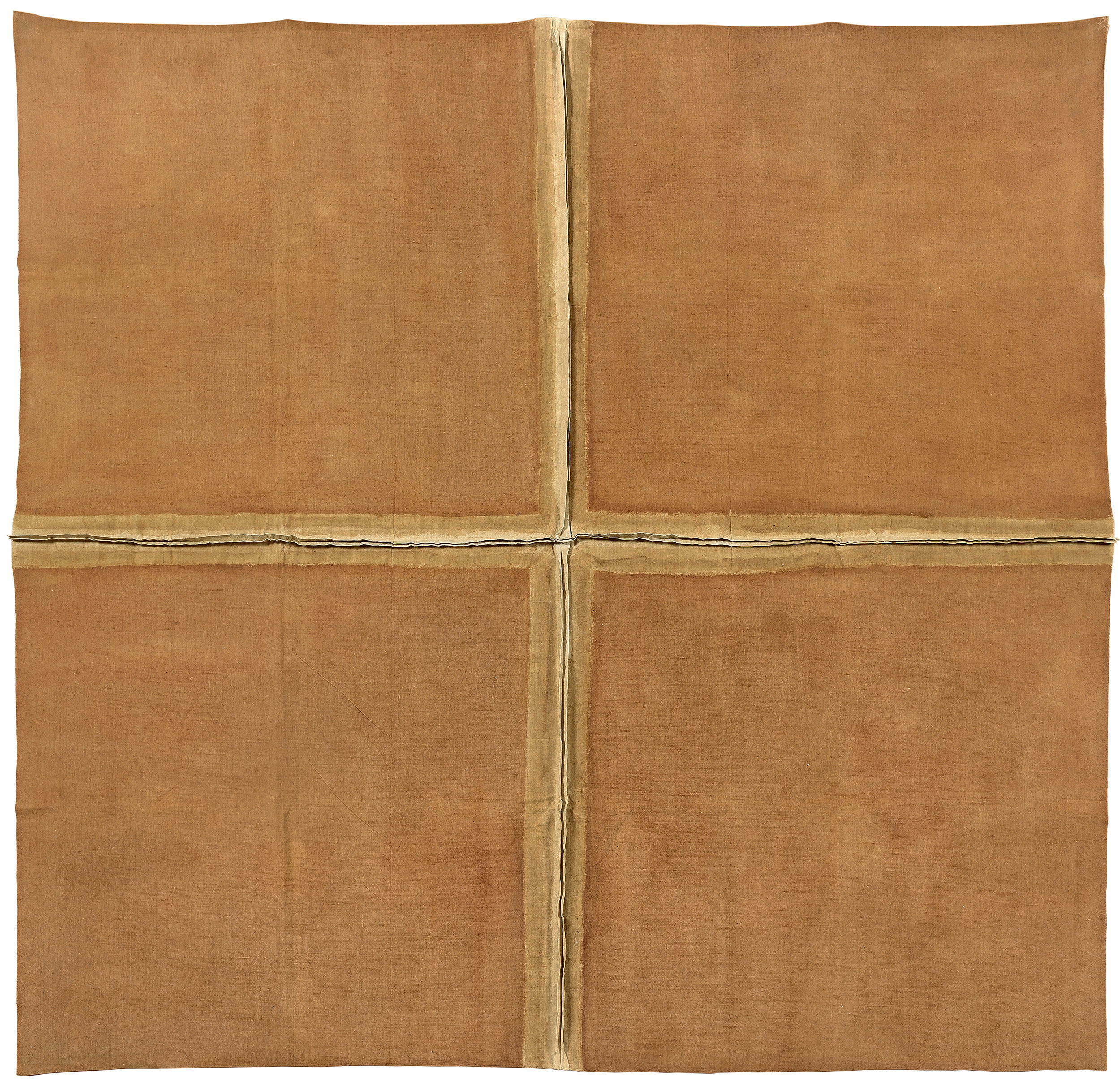
Croix, 1974
Colle et huile sur toile libre 283 x 283 cm Achat avec l’aide du FRAM, 1982
Inv. 982.6.94
De 1973 à 1975, Noël Dolla développe sa série des Croix, marquant le retour de la couleur dans sa pratique artistique. Le tableau est également suggéré par la frontalité de l’œuvre qui se compose de quatre panneaux de tailles identiques, cousus ensemble et imprégnés de points de couleurs qui envahissent la surface de la toile jusqu’à saturation.
Les coutures des panneaux ainsi assemblés forment un relief en forme de croix ou de châssis. Les éléments habituellement en bordure d’une peinture forment alors le motif principal de l’œuvre.
Comme l’explique l’artiste, son intervention se veut minimale « le geste de peindre était mis à distance des affects par une pratique simple et répétitive, proche de celle du peintre en bâtiment … »
Noël Dolla
Nice 1945
Artist of the school of Nice, Noël Dolla is one of those who, at the end of the 60s, contribute to the birth of a new artistic practice based on the deconstruction of the painting. Before becoming an artist, Dolla started out as a house painter and discovered materials such as tarlatan (a very loose cotton fabric) which would play an essential role in his work. In 1967, rejecting the traditional codes of the painting that he considers as a field of experimentation, he presents Structure étendoir, a canvas without frame suspended in space.
From 1968, Noël Dolla participates in the adventure that sees the birth of the group Supports/Surfaces His surprising interventions in nature around Nice - rocks painted in pink (1969), circles of 30m in diameter painted in the snow (1970) - propel him on the European artistic scene. The Supports/Surfaces period is marked by the creation of abstract works, sometimes on free canvas, or on simple industrial fabrics.
Croix, 1974
Glue and oil on canvas 283 x 283 cm Purchased with the help of the FRAM, 1982
Inv. 982.6.94
From 1973 to 1975, Noël Dolla developed his Crosses series, marking the return of colour to his artistic practice. The painting is also suggested by the frontal nature of the work, which is composed of four panels of identical size, sewn together and impregnated with dots of colour that invade the surface of the canvas until they are saturated.
The seams of the assembled panels form a relief in the form of a cross or frame. The elements usually at the edge of a painting then form the pattern of the work.
As the artist explains, his intervention is minimal: “the gesture of painting was distanced from affects by a simple and repetitive practice, close to that of the house painter...”.
Noël Dolla
Nizza 1945
Artista della scuola di Nizza, Noël Dolla è uno di quelli che, alla fine degli anni 60, contribuiscono alla nascita di una nuova pratica artistica basata sulla deconstruzione della pittura. Prima di diventare un artista, Dolla ha iniziato come imbianchino e ha scoperto materiali come il tarlatan (un tessuto di cotone molto sciolto), che avrà un ruolo essenziale nel suo lavoro. Nel 1967, rifiutando i codici tradizionali della pittura che considera come un campo di sperimentazione, presenta Structure étendoir, una tela senza cornice sospesa nello spazio.
Dal 1968, Noël Dolla partecipa all’avventura che vede la nascita del gruppo Supporti/Surfaci. I suoi sorprendenti interventi nella natura nei dintorni di Nizza - rocce dipinte di rosa (1969), cerchi di 30m di diametro dipinti nella neve (1970) - lo proiettano sulla scena artistica europea. Il periodo dei Supporti/Superfici è segnato dalla creazione di opere non figurativo, a volte su tele libere, o su semplici tessuti industriali.
Croix, 1974
Colla e olio su tela 283 x 283 cm Acquistato con l’aiuto del FRAM, 1982
Inv. 982.6.94
Dal 1973 al 1975, Noël Dolla sviluppa la sua serie Crosses, che segna il ritorno del colore nella sua pratica artistica. Il dipinto è suggerito anche dalla natura frontale dell’opera, che è composta da quattro pannelli di dimensioni identiche, cuciti insieme e impregnati di punti di colore che invadono la superficie della tela fino a saturarla.
Le cuciture dei pannelli così assemblati formano un rilievo a forma di croce o cornice. Gli elementi che di solito si trovano sul bordo di un quadro formano poi il mottivo dell’opera.
Come spiega l’artista, il suo intervento è minimo: «il gesto della pittura è stato distanziato dagli affetti da una pratica semplice e ripetitiva, vicina a quella del pittore nella costruzione...»
Simon Hantaï
Bia/Hongrie- Paris 2008
Elève à l’école des Beaux-Arts de Budapest, il s’installe à Paris en 1949.
Il adhère au mouvement Surréaliste de 1951 à 1954. Après une rupture avec André Breton, il s’en détache et adopte, sous l’influence de Pollock, une écriture gestuelle. Reconnu comme le précurseur du mouvement Supports/Surfaces il abandonne peu à peu la toile montée sur châssis. La toile libre est alors travaillée selon une technique de pliage propre à l’artiste dont il réalisera 8 séries correspondant à 8 manières de plier
Etude Hommage à Reverdy 1969
Acrylique sur toile 251 x 212 cm Achat 1981
Inv. : 980.7.48
De 1968 à 1969, Hantaï réalise des Etudes en hommage à Pierre Reverdy (1889-1960, poète) dans lesquelles le support est apprêté de blanc, plié et recouvert d’une couleur unique, ici le vert. L’œuvre se révèle une fois dépliée et mise à plat. Elle laisse apparaitre alors de larges formes blanches irrégulières ressemblant souvent à des feuilles de châtaigner.
Elles peuvent évoquer les papiers découpés de Matisse. Les formes ainsi créées sont le résultat du hasard, l’artiste maitrise sa technique mais n’a aucune emprise sur le résultat final.
Simon Hantaï
Bia/Hungary - Paris 2008
A student at the Budapest School of Fine Arts, he moved to Paris in 1949.
He joined the Surrealist movement from 1951 to 1954. After a break with André Breton, he detaches himself from them and adopts, under the influence of Pollock, a gestural writing. Recognized as the precursor of the movement Supports/Surfaces, he gradually abandons the canvas mounted on frame. The canvas free is then worked according to a folding technique specific to the artist which he will make 8 series corresponding to 8 ways of folding
Etude Hommage à Reverdy 1969
Acrylic on canvas 251 x 212 cm Purchase 1981
Inv. : 980.7.48
From 1968 to 1969, Hantaï made Etudes (studies) in homage to Pierre Reverdy (1889-1960, poet) in which the support is primed with white, folded and covered with a single colour, here green. The work reveals itself once unfolded and laid flat. It then reveals large irregular white shapes often resembling chestnut leaves.
They can evoke Matisse’s paper cut-outs. The shapes thus created are the result of chance, the artist masters his technique but has no control over the final result.
Simon Hantaï
Bia/Ungheria- Parigi 2008
Studente alla Scuola di Belle Arti di Budapest, si trasferì a Parigi nel 1949.
Ha aderito al movimento Surrealista dal 1951 al 1954. Dopo una rottura con André Breton, si staccò dal Surrealismo e, sotto l’influenza di Pollock, adottò uno stile gestuale. Riconosciuto come precursore del movimento Supporti/Surfaci egli abbandona progressivamente la tela montata su telaio. Il canvas libero è allora lavorato secondo una tecnica di piegatura specifica dell’artista di cui farà 8 serie corrispondenti ad 8 modi di piegatura
Etude Hommage à Reverdy 1969
Acrilico su tela 251 x 212 cm Acquisto 1981
Inv. : 980.7.48
Dal 1968 al 1969, Hantaï realizza Etudes (studio) in omaggio a Pierre Reverdy (1889-1960, poeta) in cui il supporto è innescato con il bianco, piegato e coperto con un solo colore, qui il verde. L’opera si rivela una volta dispiegata e stesa. Poi rivela grandi forme bianche irregolari che spesso assomigliano a foglie di castagno.
Possono evocare i ritagli di carta di Matisse. Le forme così create sono il risultato del caso, l’artista padroneggia la sua tecnica ma non ha alcun controllo sul risultato finale.
Jean-Pierre Pincemin
Paris 1944 – Arcueil 2005
Employé comme tourneur jusqu’en 1974, Pincemin aborde la peinture en autodidacte et fréquente régulièrement, depuis l’âge de quinze ans, le Louvre. En 1969, à l’Ecole d’architecture de Paris, il organise avec Claude Viallat une exposition avec des artistes qui formeront Supports/Surfaces. Il adhère au groupe de 1971 à 1973.
En 1974, il débute la série des Palissades qu’il poursuit jusqu’en 1980. A partir des années 80, Pincemin continue son travail sur la couleur tout en s’orientant vers la représentation figurative. Il réalise également des tableaux abstraits divisés en larges bandes colorées monochromes de tailles inégales. Il explore dans l’ensemble de son œuvre, la peinture dans tous ses états : décomposée, sur divers supports, abstraite, figurative, monochrome. Cette liberté créative lui permet de ne pas se limiter à ce seul médium au cours de sa vie et de développer également un travail de sculpture et de gravure.
C’est en 1974 que Jean-Pierre Pincemin débute la série des Palissades dont fait partie l’huile sur toile Sans titre.
Le grand format de cette œuvre, sa frontalité ainsi que son titre tendent à évoquer et figurer une palissage, tout en étant également une œuvre abstraite géométrique rythmée par les éléments horizontaux et verticaux.
A cette période l’artiste entame une recherche presque expérimentale sur la peinture, utilisant de grandes toiles libres (sans châssis ). Les « planches » de la palissade sont délimitées par des traits noirs qui apportent du contraste. La couleur générale, presque monochrome, est composée d’une infinité de variations dues à la technique de la brosse employée par l’artiste. L’ajout successif de couches de peinture donne un aspect épais et texturé et crée l’illusion d’empreintes que l’on aperçoit sur la surface de la couche picturale, rappelant les nervures du bois.
Sans titre, 1974
Huile sur toile libre 259 x 244 cm Achat avec l’aide du FRAM, 1982
Inv. 982.6.88
Jean-Pierre Pincemin
Paris 1944 - Arcueil 2005
Employed as a turner until 1974, Pincemin began painting as a self-taught artist and regularly visited the Louvre from the age of fifteen. In 1969, at the School of Architecture in Paris, he organized an exhibition with Claude Viallat with artists who were to form Supports/Surfaces. He joined the group from 1971 to 1973.
In 1974, he began the series of Palissades which he continued until 1980. From the 1980s on, Pincemin continued his work on color while moving towards figurative representation. He also created abstract paintings divided into large monochrome colored bands of unequal size. He explores in all his work, painting in all its states: decomposed, on various supports, abstract, figurative, monochrome. This creative freedom allows him not to limit himself to this medium alone during his life and to also develop a work of sculpture and engraving.
It was in 1974 that Jean-Pierre Pincemin began the series of Palissades of which the oil on canvas Untitled is a part.
The large format of this work, its frontality as well as its title tend to evoke and represent a trellis, while also being a geometric abstract work with horizontal and vertical elements.
During this period, the artist began an almost experimental research on painting, using large free canvases (without a frame). The “boards” of the palisade are delimited by black lines that provide contrast. The general colour, almost monochrome, is composed of an infinite number of variations due to the brush technique used by the artist. The successive addition of layers of paint gives a thick, textured appearance and creates the illusion of imprints that can be seen on the surface of the paint layer, reminiscent of the veins of wood.
Sans titre, 1974
Oil on canvas free 259 x 244 cm Purchased with the help of the FRAM, 1982
Inv. 982.6.88
Jean-Pierre Pincemin
Parigi 1944 - Arcueil 2005
Impiegato come tornitore fino al 1974, Pincemin si avvicina alla pittura come autodidatta e frequenta regolarmente, dall’età di quindici anni, il Louvre. Nel 1969, alla Scuola di Architettura di Parigi, organizza con Claude Viallat una mostra con gli artisti che formeranno Supporti/Surperfici. Ha fatto parte del gruppo dal 1971 al 1973.
Nel 1974, iniziò la serie di Palissades che continuò fino al 1980. A partire dagli anni ’80, Pincemin continua il suo lavoro sul colore e si orienta verso la rappresentazione figurativa. Crea anche quadri abstratti divisi in grandi bande monocromatiche colorate di dimensioni disuguali. In tutta la sua opera, esplora la pittura in tutti i suoi stati: scomposta, su vari supporti, astratta, figurativa, monocroma. Questa libertà creativa gli permette di non limitarsi solo a questo mezzo durante la sua vita e di sviluppare anche un lavoro di scultura e di incisione.
È nel 1974 che Jean-Pierre Pincemin inizia la serie delle Palissades di cui fa parte l’olio su tela Untitled.
Il grande formato di quest’opera, la sua frontalità così come il suo titolo tendono ad evocare e rappresentare un traliccio, pur essendo anche un’opera astratta geometrica punteggiata da elementi orizzontali e verticali.
Durante questo periodo, l’artista inizia una ricerca quasi sperimentale sulla pittura, utilizzando grandi tele libere (senza telaio). Le «tavole» della palizzata sono delimitate da linee nere che portano contrasto. Il colore generale, quasi monocromo, è composto da un numero infinito di variazioni dovute alla tecnica del pennello utilizzata dall’artista. L’aggiunta successiva di strati di pittura dà un aspetto spesso e strutturato e crea l’illusione di impronte visibili sulla superficie dello strato pittorico, che ricordano le venature del legno.
Sans titre, 1974
Olio su tela 259 x 244 cm Acquistato con l’aiuto del FRAM, 1982
Inv. 982.6.88
Claude Viallat
Nîmes 1936
Il étudie à l’école des beaux-arts de Montpellier de 1955 à 1959, puis aux Beaux-Arts de Paris en 1962 et 1963. Dès 1965, il abandonne le châssis selon la théorie de la déconstruction du tableau. L’année suivante, il met en place son vocabulaire pictural en adoptant et répétant toujours le même motif pictural, une empreinte de diverses couleurs, de forme abstraite qui devient sa signature. Les couleurs choisies, en parfaite harmonie les unes par rapport aux autres, sont associées par paire : l’une pour l’intérieur des formes, l’autre pour l’extérieur. Les supports sont variés et évoluent au fil des ans (toiles, tapis, bâches, parasols, tentes…).
Viallat est également l’un des cofondateurs du groupe Supports/Surfaces mais il s’en sépare en 1971. A partir de 1976, il réalise ses premières peintures sur bâche ou sur tente militaire et souligne les découpes et les contours par des couleurs.
Les œuvres de Viallat, parfois de dimensions importantes, s’imposent dans l’espace et nous entraînent dans un tourbillon coloré que génère la répétition du motif.
Sans titre, 1968
Acrylique sur toile libre 316,5 x 216,5 cm Achat, 1980
Inv. 980.7.47
L’empreinte mis au point par Viallat qui n’est « ni géométrique, ni figurative, ni symbolique » est répétée systématiquement sur une toile sans châssis, flottante.
Le motif orange est reproduit sur toute la surface de la toile, coupé en haut et sur les côtés de l’œuvre comme s’il continuait à l’infini en dehors du support.
Des décalages dans le rythme du motif sont perceptibles. Ils nous indiquent que cette répétition n’est pas mécanique mais réalisée manuellement par Claude Viallat. L’intervention de l’artiste sur la toile est minimale.
Dès 1968, l’artiste questionne et déconstruit la peinture en abandonnant le châssis et en développant un protocole radical
Claude Viallat
Nîmes 1936
He studied at the School of Fine Arts in Montpellier from 1955 to 1959, then at the Beaux-Arts in Paris in 1962 and 1963. In 1965, he abandoned the frame according to the theory of the déconstruction of the picture. The following year, he set up his pictorial vocabulary by adopting and repeating always the same pictorial pattern, an imprint of various colors, of abstract form which becomes his signature. The chosen colors, in perfect harmony with each other, are associated in pairs: one for the interior of the forms, the other for the exterior. The supports are varied and evolve over the years (canvases, carpets, tarpaulins, parasols, tents...).
Viallat is also one of the co-founders of the group Supports/Surfaces but he separates from it in 1971. From 1976 onwards, he produced his first paintings on tarpaulin or military tent and emphasized the cuts and contours with colors.
Viallat’s works, sometimes of large dimensions, impose themselves in space and draw us into a colorful whirlwind generated by the repetition of the pattern.
Sans titre, 1968
Acrylic on canvas 316.5 x 216.5 cm Purchase, 1980
Inv. 980.7.47
The print developed by Viallat which is “neither geometric, nor figurative, nor symbolic” is repeated systematically on a stretcherless, floating canvas.
The orange pattern is reproduced over the entire surface of the canvas, cut off at the top and sides of the work as if it continued endlessly outside the support.
Shifts in the rhythm of the pattern are noticeable. They indicate to us that this repetition is not mechanical, but is done manually by Claude Viallat. The artist’s intervention on the canvas is minimal.
From 1968, the artist questioned and deconstructed painting by abandoning the stretcher and developing a radical protocol
Claude Viallat
Nîmes 1936
Ha studiato alla Scuola di Belle Arti di Montpellier dal 1955 al 1959, poi alle Beaux-Arts de Paris nel 1962 e 1963. Nel 1965, abbandona la cornice secondo la teoria della déconstruzione del picture. L’anno seguente, stabilisce il suo vocabolario pittorico adottando e ripetendo sempre lo stesso motivo pittorico, un’impronta di vari colori, di forma astratta che diventa la sua firma. I colori scelti, in perfetta armonia tra loro, sono associati in coppia: uno per l’interno delle forme, l’altro per l’esterno. I supporti sono vari ed evolvono nel corso degli anni (tela, tappeti, teloni, ombrelloni, tende...).
Viallat è anche uno dei co-fondatori del gruppo Supports/Surfaces ma se ne separa nel 1971. A partire dal 1976, realizza i suoi primi pitture su telone o tenda militare e sottolinea i tagli e i contorni con i colori.
Le opere di Viallat, a volte di grandi dimensioni, si impongono nello spazio e ci trascinano in un vortice colorato generato dalla ripetizione del motivo.
Sans titre, 1968
Acrilico su tela 316,5 x 216,5 cm Acquisto, 1980
Inv. 980.7.47
La stampa sviluppata da Viallat che non è «né geometrica, né figurativa, né simbolica» si ripete sistematicamente su una tela fluttuante senza telaio.
Il motivo arancione è riprodotto su tutta la superficie della tela, tagliato in alto e ai lati dell’opera come se continuasse all’infinito fuori dal sostegno.
I cambiamenti nel ritmo del motivo sono evidenti. Essi indicano che questa ripetizione non è meccanica, ma è fatta manualmente da Claude Viallat. L’intervento dell’artista sulla tela è minimo.
Dal 1968, l’artista mette in discussione e decostruisce il pittura abbandonando il telaio e sviluppando un protocollo radicale