Robert Combas Robert Combas Robert Combas
Lyon 1957 Lyon 1957 Lyon 1957
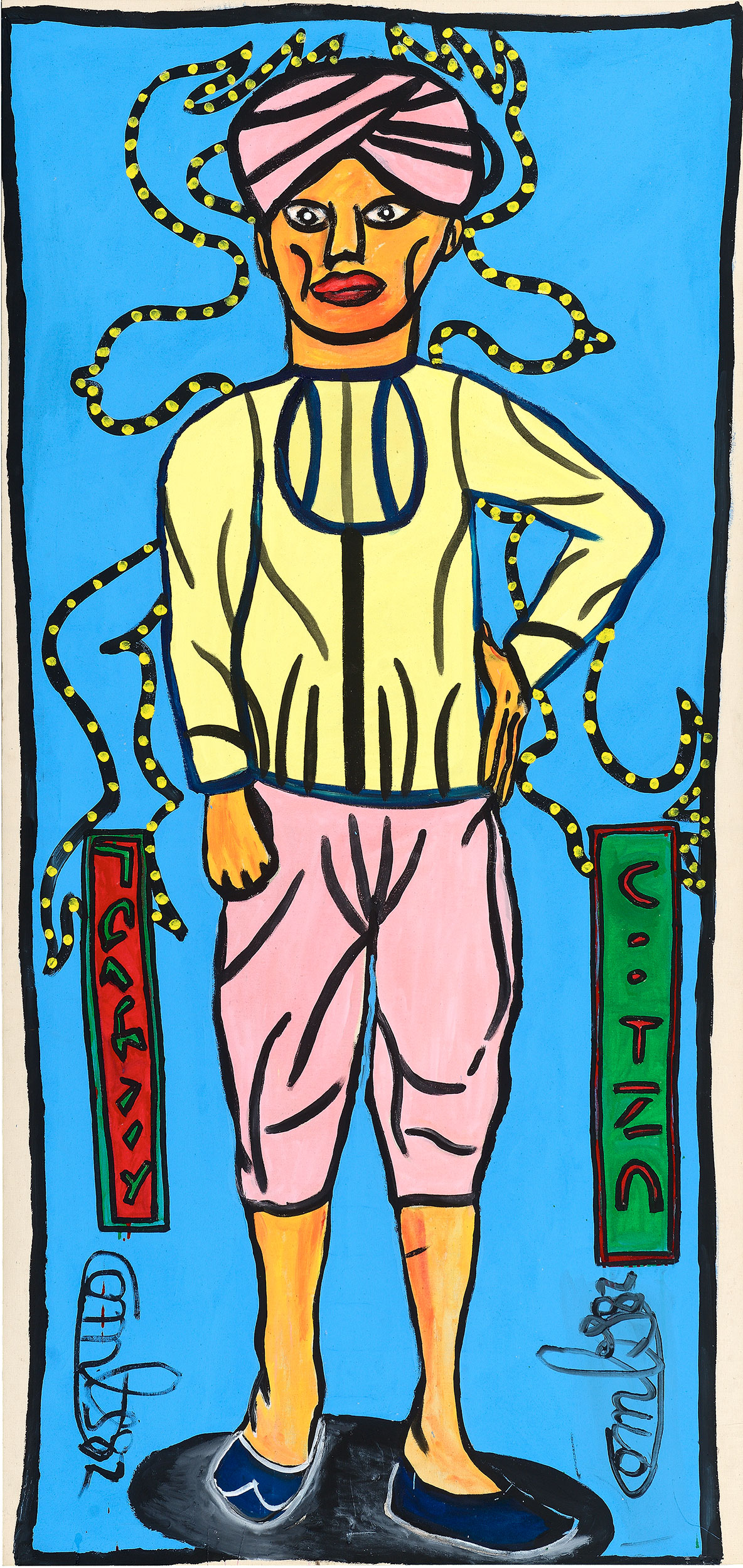
Don Nahon, 1982
Le fakir est un personnage important dans la culture populaire des années 1950-1960. A l’époque, on retrouve cette figure décalée, presque caricaturale, dans des sketchs et des BD telle que Tintin. Musicien, chanteur, conteur, adepte de la transe, le fakir est un individu important dans la culture musulmane. Le personnage est intégré de manière très frontale dans un espace coloré délimité d’un contour noir, comme à l’intérieur d’une case. On retrouve également le cerne noir et l’écriture, si chers à l’artiste.
La signature de Robert Combas de chaque côté de l’œuvre, ainsi que les sortes d’idéogrammes inventés par l’artiste évoquent une forme de cartouche égyptien
Don Nahon, 1982
The fakir is an important character in the popular culture of the 1950s-1960s. At the time, this quirky, almost caricatured figure could be found in sketches and comics such as Tintin. Musician, singer, storyteller, adept at trance, the fakir is an important individual in Muslim culture. The character is integrated in a very frontal way in a coloured space delimited by a black contour, as inside a box. We also find the black outline and the writing, so dear to the artist.
The signature of Robert Combas on each side of the work, as well as the sorts of ideograms invented by the artist, evoke a form of Egyptian cartouche
Don Nahon, 1982
Il fachiro è un personaggio importante nella cultura popolare degli anni 1950-1960. All’epoca, questa figura eccentrica, quasi caricaturale, si poteva trovare in schizzi e fumetti come Tintin. Musicista, cantante, narratore, esperto di trance, il fachiro è un individuo importante nella cultura musulmana. Il personaggio è integrato in modo molto frontale in uno spazio colorato delimitato da un contorno nero, come dentro una scatola. Troviamo anche il contorno nero e la scritta, tanto cari all’artista.
La firma di Robert Combas su ogni lato dell’opera, così come i tipi di ideogrammi inventati dall’artista evocano una forma di cartiglio egiziano
libre