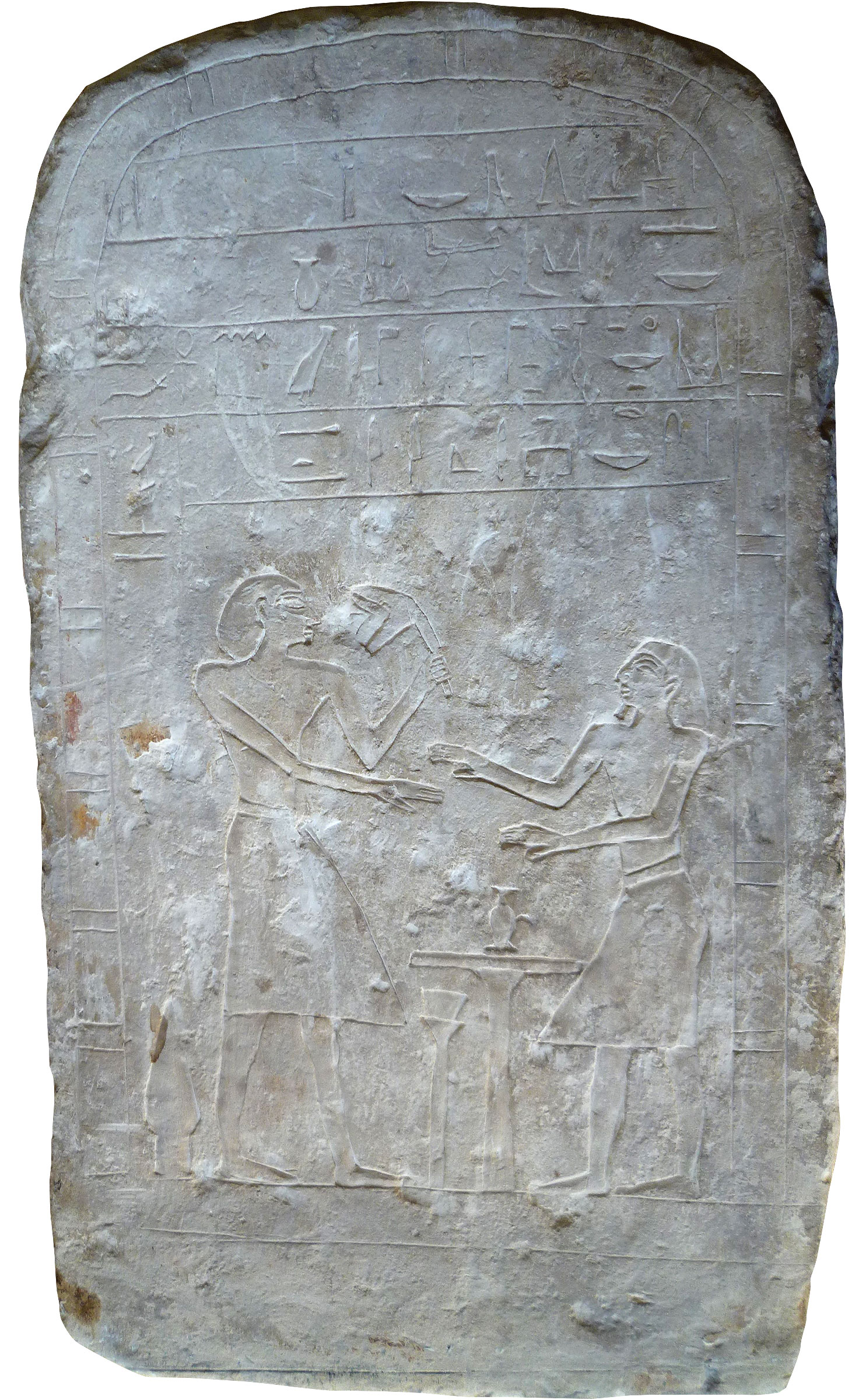


La stèle en calcaire porte un décor gravé dans le creux où figure une scène d’offrande ou d’intercession légendée de quatre lignes de hiéroglyphes en partie supérieure. Deux personnages séparés par une table d’offrandes se font face. Le personnage de gauche, le défunt, est debout tourné vers la droite, torse nu et pagne court, pieds nus. Son bras droit est fléchi vers la table, paume vers le bas et sa main gauche amène une fleur de papyrus, symbole de renaissance. Il porte une perruque courte et une petite barbe. Le personnage de droite est un homme debout tourné vers la gauche, torse nu et pagne court, pieds nus, bras fléchis vers la table, paumes vers le bas. Il porte une perruque courte et une petite barbe. La table d’offrandes soutient un vase, un arbre est figuré derrière la jambe du personnage de gauche.
Les hiéroglyphes sont gravés en creux très fin. Ils sont tracés rapidement et sans formule funéraire canonique. Une frise ornée de paires de barrures placées régulièrement orne les deux montants et le cintre. Des traces de peinture ancienne sont visibles sur le bord gauche.
La facture grossière des inscriptions fait penser à une production de province, une tentative de copie des productions royales de l’Ancien Empire. Cependant, la coiffe arrondie, les yeux en forme d’amande et la barbe sont caractéristiques d’une production asiatique inspirée de l’art égyptien (Hyksos ou peuple du Proche-Orient).*
L’art égyptien déstructuré pendant les périodes « intermédiaires ». L’Egypte antique connaît deux périodes dites « intermédiaires » durant lesquelles l’art s’essouffle. Lors de la Première Période Intermédiaire (vers 2200 à 2000 avant J.-C), l’Egypte subit une succession de heurts qui opposent le Sud, dont une partie est fidèle au souverain légitime, et le Nord soumis à la pression des Asiatiques sur les marges du Delta. A l’effondrement des structures politiques et administratives correspond une perte des valeurs et des principes d’un art respectueux des usages et des canons. On constate ainsi sur les parois des tombes, les stèles et les sarcophages, et dans la statuaire, que les personnages qui s’inscrivaient auparavant dans un canon précis, sont mal proportionnés. De même, les objets qui étaient fixés selon un ordre et agencement précis, sont placés de façon aléatoire dans l’espace. Les artistes ne produisent pas de créations ; ils copient ou reprennent des modèles antérieurs.
L’art des Hyksôs.
La Deuxième Période Intermédiaire (vers 1700 à 1550 avant J.-C) voit la fin du Moyen Empire et l’invasion des Hyksos. Ces « Princes du désert » proviennent du Proche-Orient. La domination Hyksôs est l’aboutissement d’une longue période d’invasion culturelle et commerciale. La ville d’Avaris, située à l’Est du Delta du Nil, devient le centre du pouvoir et le carrefour de multiples influences culturelles entre les Egyptiens, les tribus nomades du sud de la Palestine et de la région des lacs Amers. Ainsi, l’art hyksôs rassemble aussi bien des caractères égyptiens qu’asiatiques, mais il se manifeste surtout par une usurpation des monuments anciens et par une importante production de scarabées. A défaut de commandes royales, les artistes exécutent des stèles et des sculptures privées commandées par la classe nouvelle parvenue au pouvoir, constituée de courtisans et de membres de l’aristocratie provinciale.
* Etude réalisée par J. Fontana et B. Herrou.
The limestone stele bears an engraved decoration in the hollow of which appears an offering or intercession scene captioned by four lines of hieroglyphs in the upper part. Two figures separated by an offering table face each other. The figure on the left, the deceased, stands facing right, bare-chested and wearing a short loincloth, with bare feet. His right arm is bent toward the table, palm downward, and his left hand brings a papyrus flower, a symbol of rebirth. He wears a short wig and a small beard. The figure on the right is a man standing facing left, bare chest and short loincloth, bare feet, arms bent toward the table, palms down. He wears a short wig and a small beard. The offering table supports a vase, a tree is shown behind the leg of the left figure.
The hieroglyphs are engraved in a very fine hollow. They are drawn quickly and without any canonical funerary formula. A frieze decorated with pairs of regularly placed bars adorns the two uprights and the arch. Traces of old paint are visible on the left edge.
The crude workmanship of the inscriptions suggests a provincial production, an attempt to copy the royal productions of the Old Kingdom. However, the rounded headdress, the almond-shaped eyes and the beard are characteristic of an Asian production inspired by Egyptian art (Hyksos or people of the Near East).*
The Egyptian art destructured during the « intermediate » periods. Ancient Egypt knows two periods known as « intermediate » during which the art loses steam. During the First Intermediate Period (around 2200 to 2000 B.C.), Egypt underwent a succession of clashes between the South, part of which was loyal to the legitimate sovereign, and the North which was subjected to the pressure of the Asians on the margins of the Delta. The collapse of political and administrative structures was accompanied by a loss of the values and principles of an art that respected customs and canons. Thus, on the walls of tombs, steles and sarcophagi, and in statuary, we see that the figures that were previously part of a precise canon are badly proportioned. In the same way, the objects that were fixed according to a precise order and arrangement, are placed in a random way in the space. The artists do not produce creations ; they copy or take up previous models.
The art of the Hyksos.} The Second Intermediate Period (ca. 1700 to 1550 BC) saw the end of the Middle Kingdom and the invasion of the Hyksos. These « Princes of the desert » come from the Near East. The Hyksos domination is the result of a long period of cultural and commercial invasion. The city of Avaris, located east of the Nile Delta, became the center of power and the crossroads of multiple cultural influences between the Egyptians, the nomadic tribes of southern Palestine and the region of the Amers lakes. Thus, Hyksos art brings together both Egyptian and Asian characters, but it manifests itself above all in the usurpation of ancient monuments and in the important production of scarabs. In the absence of royal commissions, the artists executed steles and private sculptures commissioned by the new class that had come to power, consisting of courtiers and members of the provincial aristocracy.
* Study by J. Fontana and B. Herrou.
La stele di pietra calcarea è decorata con una scena incisa di offerta o intercessione con quattro linee di geroglifici nella parte superiore. Due figure si fronteggiano, separate da una tavola d’offerta. La figura a sinistra, il defunto, sta in piedi rivolto a destra, a torso nudo, con un perizoma corto e i piedi nudi. Il suo braccio destro è piegato verso il tavolo, con il palmo verso il basso, e la sua mano sinistra tiene un fiore di papiro, un simbolo di rinascita. Indossa una parrucca corta e una piccola barba. La figura a destra è un uomo in piedi e rivolto a sinistra, a torso nudo con un perizoma corto, a piedi nudi, le braccia piegate verso il tavolo, i palmi verso il basso. Indossa una parrucca corta e una piccola barba. La tavola d’offerta sostiene un vaso, e un albero è mostrato dietro la gamba della figura sinistra.
I geroglifici sono scolpiti in una depressione molto fine. Sono disegnati rapidamente e senza una formula funeraria canonica. Un fregio con coppie di barre disposte regolarmente decora i due montanti e l’arco. Tracce di vecchia vernice sono visibili sul bordo sinistro.
La crudezza delle iscrizioni suggerisce una produzione provinciale, un tentativo di copiare le produzioni reali dell’Antico Regno. Tuttavia, il copricapo arrotondato, gli occhi a mandorla e la barba sono caratteristici di una produzione asiatica ispirata all’arte egizia (Hyksos o popolo del Vicino Oriente).
L’arte egiziana destrutturata durante i periodi « intermedi ». L’antico Egitto conosce due periodi chiamati « intermedi » durante i quali l’arte si esaurisce. Durante il Primo Periodo Intermedio (circa 2200-2000 a.C.), l’Egitto subì una successione di scontri tra il Sud, parte del quale era fedele al legittimo sovrano, e il Nord, che era sotto la pressione degli asiatici ai margini del Delta. Il crollo delle strutture politiche e amministrative fu accompagnato dalla perdita dei valori e dei principi di un’arte che rispettava i costumi e i canoni. Così, sulle pareti delle tombe, sulle stele e sui sarcofagi, e nella statuaria, vediamo che le figure che prima facevano parte di un canone preciso sono mal proporzionate. Allo stesso modo, gli oggetti che erano fissati in un ordine e in una disposizione precisi sono collocati in modo casuale nello spazio. Gli artisti non producono creazioni ; copiano o riprendono modelli precedenti.
L’arte degli Hyksos.
Il Secondo Periodo Intermedio (dal 1700 al 1550 a.C. circa) vide la fine del Medio Regno e l’invasione degli Hyksos. Questi « principi del deserto » venivano dal Vicino Oriente. La dominazione Hyksos fu il risultato di un lungo periodo di invasione culturale e commerciale. La città di Avaris, situata a est del delta del Nilo, divenne il centro del potere e il crocevia di molteplici influenze culturali tra gli egiziani, le tribù nomadi della Palestina meridionale e la regione dei Laghi Amari. Così, l’arte Hyksos riunisce caratteri egiziani e asiatici, ma si manifesta principalmente con un’usurpazione di monumenti antichi e con un’importante produzione di scarabei. In assenza di commissioni reali, gli artisti eseguirono stele e sculture private commissionate dalla nuova classe che arrivò al potere, composta da cortigiani e membri dell’aristocrazia provinciale.
* Studio di J. Fontana e B. Herrou.