Minimalistes, conceptualistes américains
Minimalists, American conceptualists
Minimalisti, concettuali americani
Le Minimalisme, aussi appelé Art minimal, apparaît aux Etats-Unis au début des années 1960. Il regroupe des peintres (Stella), des sculpteurs et des musiciens (Glass, La Monte Young…) réunis par la même volonté de simplicité, de neutralité et d’efficacité.
Les artistes américains minimalistes sont partisans de la fameuse phrase « Less is more » (Moins, c’est plus) que prône l’architecte Mies van der Rohe (membre du Bauhaus). Les structures sont donc simples, géométriques (Sol LeWitt), équilibrées et présentées de façon conceptuelle afin de créer un rapport fort à l’espace et surtout à la lumière (Dan Flavin, Donald Judd). Leurs formes et leurs volumes sont souvent répétés et constitués en série (Donald Judd et Sol LeWitt) avec des matériaux et des moyens de production industriels.
Ce mouvement ouvre la voie au conceptualisme (art conceptuel).
Minimalism, also called Minimal art, appeared in the United States in the early 1960s. It gathers painters (Stella), sculptors and musicians (Glass, La Monte Young...) united by the same will of simplicity, neutrality and efficiency.
American minimalist artists are supporters of the famous phrase « Less is more » advocated by the architect Mies van der Rohe (member of the Bauhaus). The structures are therefore simple, geometric (Sol LeWitt), balanced and presented in a conceptual way in order to create a strong relationship to the space and especially to the light (Dan Flavin, Donald Judd). Their forms and their volumes are often repeated and constituted in series (Donald Judd and Sol LeWitt) with materials and industrial means of production.
This movement opens the way to conceptualism (art conceptual).
Il Minimalismo, chiamato anche Arte minima, è apparso negli Stati Uniti nei primi anni sessanta. Riunisce pittori (Stella), scultori e musicisti (Glass, La Monte Young...) uniti dallo stesso desiderio di semplicità, neutralità ed efficienza.
Gli artisti minimalisti americani sono sostenitori della famosa frase « Less is more » sostenuta dall’architetto Mies van der Rohe (membro del Bauhaus). Le strutture sono quindi semplici, geometriche (Sol LeWitt), bilanciate e presentate in modo concettuale per creare un forte rapporto con lo spazio e soprattutto con la luce (Dan Flavin, Donald Judd). Le loro forme e volumi sono spesso ripetute e costituite in serie (Donald Judd e Sol LeWitt) con materiali e mezzi di produzione industriali.
Questo movimento apre la strada al concettualismo (arte concettuale).
Conceptuel
Conceptual
Concettuale
Se dit d’une tendance qui fait primer l’idée sur la réalité matérielle de l’œuvre, d’un artiste, d’un travail qui appartiennent à cette tendance.
Said of a tendency that gives priority to the idea over the material reality of the work, of an artist, of a work that belongs to this tendency.
Detto di una tendenza che antepone l’idea alla realtà materiale dell’opera, di un artista, di un’opera che appartiene a questa tendenza.
Espace
Space
Spazio
Propriété particulière d’un objet qui fait que celui-ci occupe un certain volume au sein d’une étendue, d’un volume nécessairement plus grand que lui et qui peut être mesuré.
Étendue indéfinie qui contient et entoure toute chose.
A particular property of an object that makes it occupy a certain volume within an expanse, a volume that is necessarily larger than it and that can be measured.
An indefinite expanse that contains and surrounds everything.
Una particolare proprietà di un oggetto che gli fa occupare un certo volume all’interno di una distesa, un volume che è necessariamente più grande di esso e che può essere misurato.
Una distesa indefinita che contiene e circonda tutto.
Industriel
Industrial
Industriale
Qui est produit par l’industrie, par une usine, de manière répétitive et mécanique.
Which is produced by industry, by a factory, in a repetitive and mechanical way.
Che è prodotto dall’industria, da una fabbrica, in modo ripetitivo e meccanico.
Installation
Installation
Installazione
Terme apparu dans les années 1970 pour le domaine artistique. Une installation artistique est une œuvre d’art visuel en trois dimensions, souvent créée pour un lieu spécifique in situ et conçue pour modifier la perception de l’espace.
Term that appeared in the 1970s for the artistic field. An art installation is a three-dimensional work of visual art, often created for a specific location in situ and designed to alter the perception of space.
Termine apparso negli anni ’70 per il campo artistico. Un’installazione artistica è un’opera tridimensionale di arte visiva, spesso creata per un luogo specifico in situ e progettata per alterare la percezione dello spazio.
Land Art
Land Art
Arte della terra
Le land art est une tendance artistique apparue vers la fin des années 60 basée sur l’utilisation de matériaux trouvés dans la nature (roches, sables, bois etc.). Souvent monumentales, ces œuvres contemporaines éphémères s’exposent à l’extérieur jusqu’à leur érosion naturelle. D’autres médiums sont parfois utilisés par l’artiste pour garder une trace de sa réalisation (photographie, vidéo etc.).
Land art is an artistic trend that emerged in the late 1960s based on the use of materials found in nature (rocks, sand, wood, etc.). Often monumental, these ephemeral contemporary works are displayed outdoors until they are naturally eroded. Other media are sometimes used by the artist to keep a trace of his work (photography, video etc.).
La « Land art » è una tendenza artistica apparsa alla fine degli anni ’60 basata sull’uso di materiali trovati in natura (rocce, sabbia, legno ecc.). Spesso monumentali, queste opere contemporanee effimere sono esposte all’aperto fino alla loro naturale erosione. Altri mezzi sono talvolta utilizzati dall’artista per conservare una traccia della sua creazione (fotografia, video ecc.).
Lumière
Light
Luce
Clarté émise par le soleil, qui éclaire les objets et les rend visibles.
Elle peut aussi être artificielle, provenant d’une source lumineuse (appareil, lampe) propre à l’éclairage.
La lumière est l’un des centres de préoccupations des artistes minimalistes et conceptualistes américains.
Brightness emitted by the sun, which illuminates objects and makes them visible.
It can also be artificial, coming from a light source (apparatus, lamp) specific to lighting.
Light is one of the concerns of American minimalist and conceptualist artists.
Luminosità emessa dal sole, che illumina gli oggetti e li rende visibili.
Può anche essere artificiale, proveniente da una fonte di luce (apparecchio, lampada) specifica per l’illuminazione.
La luce è una delle preoccupazioni degli artisti minimalisti e concettuali americani.
Minimalisme
Minimalism
Minimalismo
Qui atteint sa plus petite valeur, son plus bas degré, son minimum.
L’Art Minimal ou Minimalisme est un courant de l’art contemporain né dans les années 1960 aux Etats-Unis, dans lequel l’intervention de l’artiste est réduite à son minimum. L’œuvre est restreinte à des formes d’une extrême simplification géométrique, ainsi qu’à des modalités élémentaires de matière ou de couleur.
Which reaches its lowest value, its lowest degree, its minimum.
Minimal Art or Minimalism is a current of contemporary art born in the 1960s in the United States, in which the artist’s intervention is reduced to its minimum. The work is restricted to forms of extreme geometric simplification, as well as to elementary modalities of material or colour.
Che raggiunge il suo valore più basso, il suo grado più basso, il suo minimo.
La Minimal Art o Minimalismo è una corrente dell’arte contemporanea nata negli anni 60 negli Stati Uniti, in cui l’intervento dell’artista è ridotto al minimo, l’opera ridotta a forme di estrema semplificazione geometrica, così come modalità elementari di materia o colore.
Performance
Performance
Performance
La Performance artistique est une tradition artistique interdisciplinaire, née vers le milieu du XXe siècle. La performance peut être une action conduite par un artiste ou d’autres participants et est, par essence, un art éphémère qui laisse peu d’objets derrière lui. C’est pourquoi sa trace est gardée par les photographies et les livres.
Performance art is an interdisciplinary artistic tradition that emerged in the mid-twentieth century. Performance art can be an action carried out by an artist or other participants and is, in essence, an ephemeral art form that leaves few objects behind. That is why its trace is kept by photographs and books.
La performance art è una tradizione artistica interdisciplinare, nata intorno alla metà del XX secolo. La performance art può essere un’azione condotta da un artista o da altri partecipanti ed è, in sostanza, una forma d’arte effimera che lascia poco. Ecco perché la sua traccia è conservata da fotografie e libri.
Sculpture
Sculpture
Scultura
Ensemble des techniques qui permettent la représentation d’un objet dans l’espace au moyen d’une matière à laquelle on impose une forme esthétique.
All the techniques that allow the representation of an object in space by means of a material to which an aesthetic form is imposed.
Un insieme di tecniche che permettono la rappresentazione di un oggetto nello spazio per mezzo di un materiale al quale viene imposta una forma estetica.
Établissement de la grande industrie destiné à la fabrication d’objets ou de produits, à la transformation de matières premières, à la production d’énergie.
Establishment of large-scale industry for the manufacture of objects or products, for the processing of raw materials, for the production of energy.
Stabilimento di grandi industrie destinate alla fabbricazione di oggetti o prodotti, alla trasformazione di materie prime, alla produzione di energia.
Donald JUDD
Excelsior Spring 1928 – New York 1994
Diplômé en philosophie et en histoire de l’art, Judd commence à peindre dans les années 1950. Dès le début des années 1960, il mène une recherche formelle et intellectuelle et abandonne la peinture. Il change complètement sa pratique artistique, et commence à créer des reliefs et des objets tridimentionnels, sans pour autant définir ses créations comme des sculptures. Dès lors, il intègre le mouvement de l’Art Minimal dont il est l’un des fervents représentant (bien qu’il renie ce terme qu’il juge trop réducteur). En 1965, il rédige Specific Objects, un texte considéré comme le manifeste de l’ArtMinimal, et définit son vocabulaire artistique avec le souci de mettre le spectateur au cœur de l’espace.
Aluminium anodisé bleu
23 x 175 x 13 cm Achat avec l’aide du FRAM, 1982
Inv. 982.6.91
Progression bleue fait partie de l’ensemble des Progressions développées par Judd. Ce sont des structures horizontales tridimensionnelles murales créées par l’artiste en suivant des suites arithmétiques. En utilisant la rigueur mathématique et en déléguant la production de ses œuvres à une usine, Judd libère son travail de toute émotion et expressivité.
Il utilise des matériaux industriels pour leur qualité visuelle. L’aluminium anodisé réfléchit la lumière environnante et des variations apparaissent à sa surface : reflets, éclats et mélange des couleurs.
En se déplaçant autour de la structure, chaque personne, selon son emplacement dans l’espace et sa hauteur aura une perception différente de l’œuvre.
Pour Judd, ce qui est important n’est pas seulement l’objet présenté au mur mais aussi ces espaces vides, ces volumes, les contrastes d’ombre ou de lumière, et son rapport à l’environnement qui l’entoure.
Donald JUDD
Excelsior Spring 1928 - New York 1994
A graduate in philosophy and art history, Judd began painting in the 1950s. From the beginning of the 1960s, he leads a formal and intellectual research and abandons painting. He completely changed his artistic practice, and began to create reliefs and three-dimensiona objects, without defining his creations as sculptures. From then on, he joined the Minimal Art movement, of which he is one of the most fervent representatives (although he denies this term, which he considers too reductive). In 1965, he wrote Specific Objects, a text considered as the manifesto of the ArtMinimal, and defines his artistic vocabulary with the concern to put the spectator in the heart of the space.
Aluminium anodisé bleu
23 x 175 x 13 cm Purchased with the help of FRAM, 1982
Inv. 982.6.91
Blue Progression is part of the set of Progressions developed by Judd. These are horizontal three-dimensional wall structures created by the artist following arithmetic sequences. By using mathematical rigour and delegating the production of his works to a [factory>562], Judd frees his work of all emotion and expressiveness.
He uses industrial materials for their visual quality. The anodised aluminium reflects the surrounding light and variations appear on its surface: reflections, glints and colour mixing.
Moving around the structure, each person, depending on their position in the space and their height, will have a different perception of the work.
For Judd, what is important is not only the object on the wall but also the empty spaces, the volumes, the contrasts of light and shadow, and its relationship to the environment around it.
Donald JUDD
Excelsior Primavera 1928 - New York 1994
Laureato in filosofia e storia dell’arte, Judd ha iniziato a dipingere negli anni 1950. Dall’inizio degli anni ’60, conduce una ricerca formale e intellettuale e abbandona la pittura. Cambia completamente la sua pratica artistica, e comincia a creare rilievi e oggetti tridimensionali, senza definire le sue creazioni come sculture. Da allora, si unì al movimento della Minimal Art, di cui è uno dei più ferventi rappresentanti (sebbene disconosca questo termine, che considera troppo riduttivo). Nel 1965, scrisse Oggetti specifici, un testo considerato come il manifesto dell’ Arte Minimal->558], e definisce il suo vocabolario artistico con la preoccupazione di mettere lo spettatore al centro dello spazio.
Aluminium anodisé bleu
23 x 175 x 13 cm Acquistato con l’aiuto del FRAM, 1982
Inv. 982.6.91
La progressione blu fa parte dell’insieme di Progressioni sviluppate da Judd. Si tratta di strutture murali orizzontali tridimensionali create dall’artista seguendo sequenze aritmetiche. Usando il rigore matematico e delegando la produzione delle sue opere a una fabbrica, Judd libera il suo lavoro da ogni emozione ed espressività.
Usa materiali industriali per la loro qualità visiva. L’alluminio anodizzato riflette la luce circostante e sulla sua superficie appaiono delle variazioni: riflessi, bagliori e mescolanza di colori.
Muovendosi intorno alla struttura, ogni persona, a seconda della sua posizione nello spazio e della sua altezza, avrà una diversa percezione dell’opera.
Per Judd, ciò che è importante non è solo l’oggetto presentato sul muro, ma anche questi spazi vuoti, questi volumi, i contrasti di luce e ombra, e la sua relazione con l’ambiente circostante.
Dan FLAVIN
New York 1933 – Id. 1996
Représentant de l’art minimal aux côtés de Donald Judd,Carl André et Sol LeWitt,Flavin utilise rapidement la lumière dans sa pratique artistique. Dès 1961, il conçoit ses premières peintures intitulées Icônes, en y introduisant sur le pourtour des ampoules et lampes électriques. En 1963, il fait du tube fluorescent, qu’il trouve directement dans le commerce (dans neuf couleurs et quatre longueurs différentes), sa seule et unique matière principale.
Suite à sa première exposition personnelle en 1964, il travaille sur la notion de perception, sur le positionnement de ses sculptures et l’effet produit pas la lumière émise dans l’espace. A partir des années 1970, il s’investit de plus en plus dans des architectures monumentales où il conçoit des installations à grande échelle (Gare centrale de New-York en 1977, Musée Guggenheim de New-York en 1992, Eglise Santa Maria Annunciata de Milan en 1996…).
Sculpture Néon
Tube fluorescent 244 x 10 x 5,5 cm Achat avec l’aide du FRAM, 1984
Inv. 985.2.55.1-2
Dan Flavin débute le travail du néon le 25 mai 1963, grâce à sa première production du type : un tube fluorescent couleur or, installé au mur dans son atelier avec une inclinaison de 45° et long de 244 cm nommé The Diagonal of May 25.
L’utilisation de ce produit industriel, facilement accessible dans le commerce, permet à l’artiste d’assouvir sa démarche d’intervention minimale. Exposés seuls dans un premier temps, Flavin développe par la suite un véritable travail d’installation en combinant plusieurs tubes colorés, également conçu in situ (réalisés pour résonner au sein d’un lieu précis).
La lumière est l’élément central de son travail. Si l’applique dans laquelle le néon se trouve à une présence matérielle, la lumière, elle, est intangible et immatérielle. Elle se reflète et se diffuse dans l’espace qui l’entoure en transformant son architecture et la perception du spectateur.
Dan FLAVIN
New York 1933 - Id. 1996
Representative of minimal art alongside Donald Judd,Carl André and Sol LeWitt,Flavin quickly used light in his artistic practice. As early as 1961, he conceived his first paintings entitled Icons, introducing light bulbs and electric lamps around their edges. In 1963, he made fluorescent tubes, which he found directly on the market (in nine colors and four different lengths), his one and only main material.
Following his first solo exhibition in 1964, he worked on the notion of perception, on the positioning of his sculptures and the effect produced by the light emitted in the space. From the 1970s onwards, he became more and more involved in monumental architecture where he designed large-scale installations (New York Central Station in 1977, Guggenheim Museum in New York in 1992, Santa Maria Annunciata Church in Milan in 1996...).
Sculpture Néon
Fluorescent tube 244 x 10 x 5.5 cm Purchased with the help of FRAM, 1984
Inv. 985.2.55.1-2
Dan Flavin began working with neon on May 25, 1963, with his first such production: a gold-coloured fluorescent tube, installed on the wall in his studio at an angle of 45° and 244 cm long named The Diagonal of May 25.
The use of this industrial product, easily accessible in the market, allows the artist to satisfy his approach of minimal intervention. Initially exhibited alone, Flavin later developed a real installation work by combining several coloured tubes, also conceived in situ (made to resonate within a specific place).
The light is the central element of his work. If the sconce in which the neon is located has a material presence, the light is intangible and immaterial. It is reflected and diffused in the space that surrounds it, transforming its architecture and the perception of the viewer.
Dan FLAVIN
New York 1933 - Id. 1996
Un rappresentante dell’arte minimal insieme a Donald Judd,Carl André e Sol LeWitt,Flavin fu veloce ad usare la luce nella sua pratica artistica. Già nel 1961, ha concepito i suoi primi quadri intitolati Icone, introducendo lampadine e lampade elettriche ai loro bordi. Nel 1963, ha fatto dei tubi fluorescenti, che ha trovato direttamente sul mercato (in nove colori e quattro lunghezze diverse), il suo unico e solo materiale principale.
Dopo la sua prima mostra personale nel 1964, ha lavorato sulla nozione di percezione, sul posizionamento delle sue sculture e sull’effetto prodotto dalla luce emessa nello spazio. Dagli anni ’70 in poi, si dedica sempre più all’architettura monumentale dove progetta grandi installazioni (Stazione Centrale di New York nel 1977, Guggenheim Museum di New York nel 1992, Chiesa di Santa Maria Annunciata a Milano nel 1996...).
Sculpture Néon
Tubo fluorescente 244 x 10 x 5,5 cm Acquistato con l’aiuto del FRAM, 1984
Inv. 985.2.55.1-2
Dan Flavin iniziò a lavorare con il neon il 25 maggio 1963, grazie alla sua prima produzione del tipo: un tubo fluorescente color oro, installato sul muro del suo studio con un angolo di 45° e lungo 244 cm chiamato The Diagonal of May 25.
L’uso di questo prodotto industriale, facilmente accessibile sul mercato, permette all’artista di soddisfare il suo approccio di intervento minimo. Esposto inizialmente da solo, Flavin sviluppò in seguito una vera e propria opera installazione combinando diversi tubi colorati, anch’essi concepiti in situ (fatti per risuonare in un luogo specifico).
La luce è l’elemento centrale del suo lavoro. Se l’applique in cui si trova il neon ha una presenza materiale, la luce è intangibile e immateriale. Si riflette e si diffonde nello spazio che lo circonda, trasformando la sua architettura e la percezione dello spettatore.
Sol LEWITT
Hartford 1928 – New York 2007
En 1953, il s’inscrit à la Cartoons Illustrations de New-York, puis travaille comme graphiste jusqu’en 1960, dans différentes agences d’architecture et de commerce. Dès 1962, il élabore ses premières œuvres qui sont inspirées de Malevitch, du Constructivisme et du Bauhaus.
D’abord minimaliste, Sol LeWitt s’engage rapidement dans une nouvelle pratique artistique. En 1967, il publie dans la revue Artforum « Les paragraphes sur l’ArtConceptuel » et devient alors un des initiateurs de ce nouveau mouvement, qui produisent leur art dans une démarche intellectuelle.
Selon l’artiste, « c’est l’idée ou le concept qui compte le plus » et qui prévaut sur l’œuvre finie. Son travail s’établit à partir de lignes géométriques horizontales et verticales et du carré. Ses œuvres sont créées à partir de protocoles (plans et instructions écrites) dont la réalisation est déléguée à des assistants. Sol LeWitt est célèbre pour ses Wall Drawings (dessin mural composé d’une série de motifs géométriques colorés), mais également pour ses Structures, terme qu’il utilise pour décrire ses sculptures.
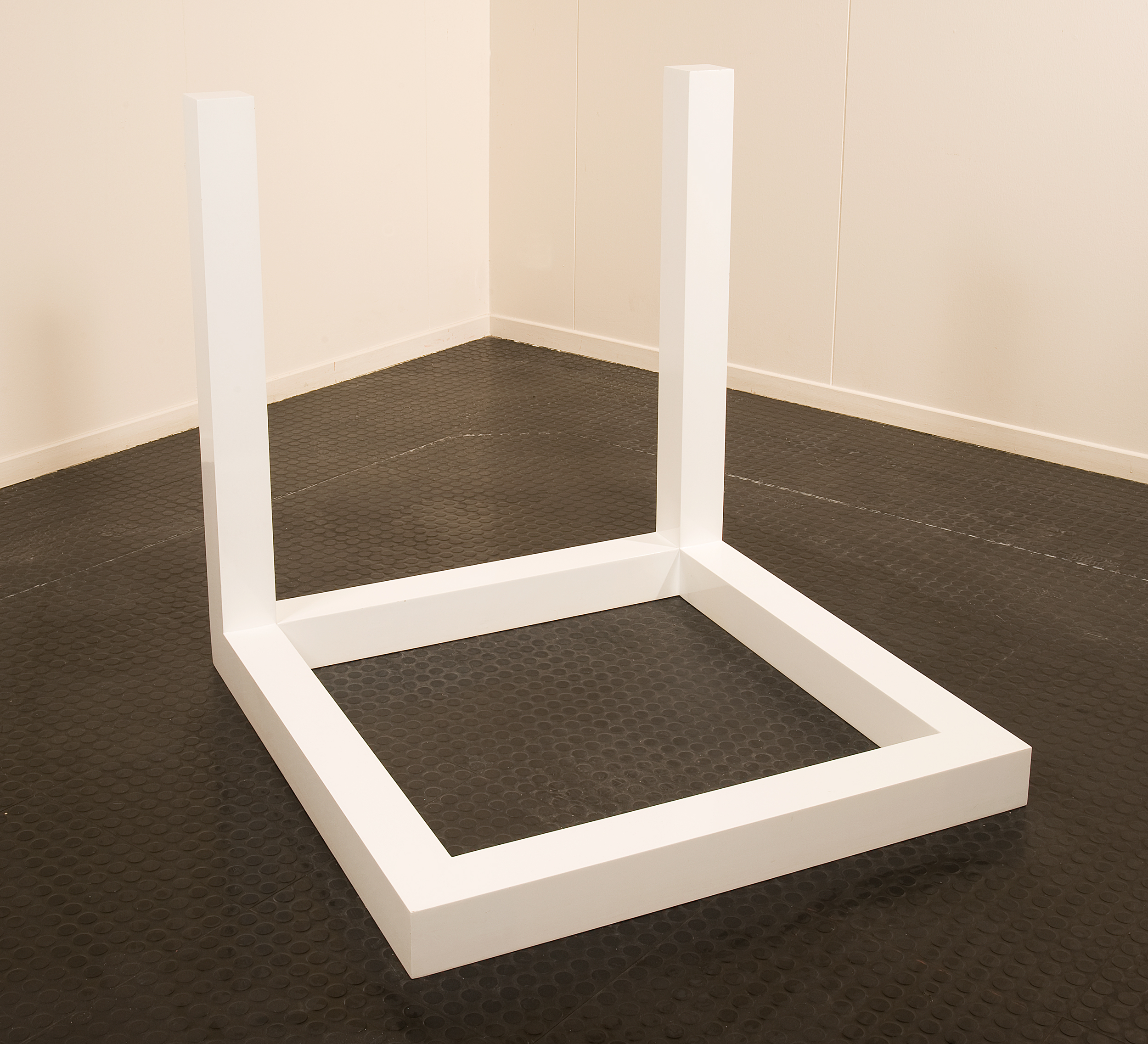
Incomplete Open Cube, 1973
Aluminium émaillé 105 x 105 x 105 cm Achat, 1981
Inv. 981.6.61
Les Incomplete Open Cubes sont des structures cubiques inachevées. Au nombre de 122 pièces elles mettent en scène la manière « de ne pas faire un cube, et les façons pour un cube de ne pas être complété ».
Contrairement aux autres artistes minimalistes et conceptualites, le rapport à l’espace importe peu pour Sol Lewitt, c’est l’agencement de tous les éléments entre eux qui l’intéresse. Chaque cube incomplet doit être considéré comme une structure à part entière qui résonne avec les autres, même si elles ne sont pas présentées ensemble.
Dans une démarche d’implication minimale, Lewitt confie la réalisation des Incomplete open cubes à une usine à laquelle il transmet ses dessins et plans. Il se détache ainsi de la conception physique. Toujours sur le modèle industriel, il utilise des certificats pour « signer » ses pièces.
Sol LEWITT
Hartford 1928 - New York 2007
In 1953, he enrolled at the Cartoons Illustrations of New York, then worked as a graphic designer until 1960, in various architectural and commercial agencies. In 1962, he developed his first works which were inspired by Malevitch, Constructivism and the Bauhaus.
Initially a minimalist, Sol LeWitt quickly committed himself to a new artistic practice. In 1967, he published in the magazine Artforum “Paragraphs on the ArtConceptual” and then becomes one of the initiators of this new movement, which produce their art in an intellectual approach.
According to the artist, “it is the idea or the concept which counts most” and which prevails on the finished work. His work is based on horizontal and vertical geometric lines and the square. His works are created from protocols (plans and written instructions) whose realization is delegated to assistants. Sol LeWitt is famous for his Wall Drawings (wall drawings composed of a series of colored geometric patterns), but also for his Structures, a term he uses to describe his sculptures.
Incomplete Open Cube, 1973
Enamelled aluminium 105 x 105 x 105 cm Purchase, 1981
Inv. 981.6.61
The Incomplete Open Cubes are unfinished cubic structures. Numbering 122 pieces they dramatise how “not to make a cube, and ways for a cube not to be completed”.
Unlike other minimalist and conceptualites artists, the relationship to space is of little importance to Sol Lewitt; it is the arrangement of all the elements in relation to each other that interests him. Each incomplete cube is to be seen as a structure in its own right that resonates with the others, even if they are not presented together.
In an approach of minimal involvement, Lewitt entrusts the realization of the Incomplete open cubes to a factory to which he transmits his drawings and plans. In this way he detaches himself from the physical design. Still on the industrial model, he uses certificates to “sign” his pieces.
Sol LEWITT
Hartford 1928 - New York 2007
Nel 1953, si iscrive alla Cartoons Illustrations di New York, poi lavora come grafico fino al 1960, in varie agenzie di architettura e commerciali. Nel 1962, sviluppa le sue prime opere che si ispirano a Malevitch, al Costruttivismo e al Bauhaus.
Inizialmente minimalista, Sol LeWitt si impegnò rapidamente in una nuova pratica artistica. Nel 1967, pubblicò nella rivista Artforum «Paragrafi sull’ ArtConcettuale» e poi divenne uno degli iniziatori di questo nuovo movimento, che produce la sua arte in un approccio intellettuale.
Secondo l’artista, «è l’idea o il concetto che conta di più» e che prevale sull’opera finita. Il suo lavoro si basa su linee geometriche orizzontali e verticali e sul quadrato. Le sue opere nascono da protocolli (piani e istruzioni scritte), la cui esecuzione è delegata ad assistenti. Sol LeWitt è famoso per i suoi Wall Drawings (un disegno murale composto da una serie di motivi geometrici colorati), ma anche per le sue Structures, un termine che usa per descrivere le sue sculture.
Incomplete Open Cube, 1973
Alluminio smaltato 105 x 105 x 105 cm Acquisto, 1981
Inv. 981.6.61
I Cubi aperti incompleti sono strutture cubiche non finite. Numerando 122 pezzi drammatizzano come «non fare un cubo, e i modi in cui un cubo può essere incompleto».
A differenza di altri artisti minimalisti e concettuali, il rapporto con lo spazio ha poca importanza per Sol Lewitt; è la disposizione di tutti gli elementi in relazione tra loro che gli interessa. Ogni cubo incompleto deve essere considerato come una struttura a sé stante che risuona con gli altri, anche se non sono presentati insieme.
In un approccio di coinvolgimento minimo, Lewitt affida la realizzazione degli Incomplete open cubes a una fabbrica alla quale trasmette i suoi disegni e progetti. Si distacca così dal disegno fisico. Sempre sul modello industriale, usa i certificati per «firmare» i suoi pezzi.