Jean-François CHAMPOLLION Jean-François CHAMPOLLION Jean-François CHAMPOLLION
Figeac, 1790 - Paris, 1832 Figeac, 1790 - Paris, 1832 Figeac, 1790 - Parigi, 1832
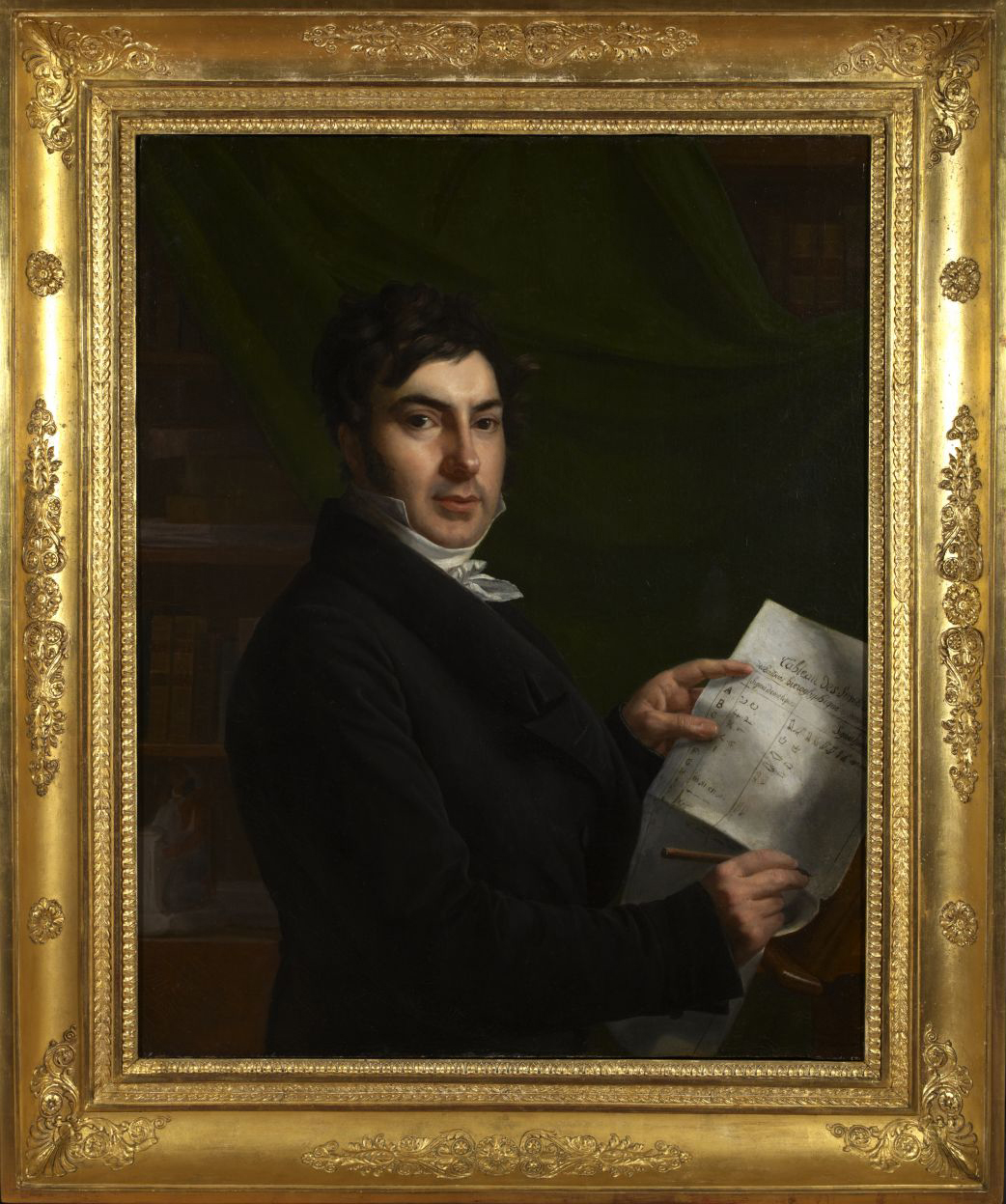
Huile sur toile
Collection Musée Champollion, Vif
Fils d’un libraire, Jean-François Champollion quitte sa famille en 1801 pour rejoindre à Grenoble son frère Jacques-Joseph, qui lui transmet son goût pour l’archéologie. Il étudie le latin, le grec, l’hébreu, l’arabe, le syriaque et le chaldéen.
Il rencontre d’anciens participants de l’expédition d’Égypte de 1798, qui lui font découvrir une passion pour l’Égypte antique. En 1807, désireux de déchiffrer les hiéroglyphes, il part à Paris où il peut consulter les manuscrits coptes de la Bibliothèque impériale. De retour à Grenoble en 1809, il est nommé, à dix-huit ans, professeur d’histoire ancienne, et l’année d’après, bibliothécaire-adjoint à la bibliothèque municipale.
En 1811, il rédige un premier ouvrage consacré à l’Égypte, Introduction à l’Égypte sous les Pharaons.
A partir de 1821, il entreprend l’étude de la pierre de Rosette, une stèle portant une inscription en trois langues, grec, démotique et hiéroglyphique. Cela lui permet de déchiffrer les noms des rois Ptolémaïques sur les monuments. En 1824, il publie sa grande découverte : Précis du système hiéroglyphique des anciens Égyptiens, ou Recherches sur les éléments premiers de cette écriture sacrée, sur leurs diverses combinaisons, et sur les rapports de ce système avec les autres méthodes graphiques égyptiennes.
En 1826, Champollion est nommé conservateur du musée Charles X et rédige le catalogue des collections égyptiennes qui constituent le premier fonds égyptien du futur musée du Louvre.
En 1828, il réalise enfin son rêve en participant à une expédition scientifique en Égypte. Durant son séjour, il explore les sites, fait de nombreux relevés et confronte son système de traduction directement sur le terrain. Ses observations sont compilées dans un ouvrage en quatre volumes, intitulé Monuments de l’Égypte et de la Nubie.
Nommé membre de l’Académie des inscriptions et belles-lettres, il devient en 1831, le premier professeur d’égyptologie du Collège de France.
Huile sur toile
Collection Musée Champollion, Vif
The son of a bookseller, Jean-François Champollion left his family in 1801 to join his brother Jacques-Joseph in Grenoble, who passed on his taste for archaeology. He studied Latin, Greek, Hebrew, Arabic, Syriac and Chaldean.
He met former participants of the Egyptian expedition of 1798, who made him discover a passion for ancient Egypt. In 1807, eager to decipher hieroglyphs, he left for Paris where he could consult the Coptic manuscripts of the Imperial Library. Back in Grenoble in 1809, he was appointed professor of ancient history at the age of eighteen, and the following year, assistant librarian at the municipal library.
In 1811, he wrote his first work on Egypt, Introduction to Egypt under the Pharaohs.
From 1821, he undertook the study of the Rosetta Stone, a stele bearing an inscription in three languages, Greek, demotic and hieroglyphic. This allowed him to decipher the names of the Ptolemaic kings on the monuments. In 1824, he published his great discovery : Precise of the hieroglyphic system of the ancient Egyptians, or Research on the first elements of this sacred writing, on their various combinations, and on the relations of this system with the other Egyptian graphic methods.
In 1826, Champollion was appointed curator of the Charles X Museum and wrote the catalog of the Egyptian collections that constituted the first Egyptian collection of the future Louvre Museum.
In 1828, he finally realized his dream by participating in a scientific expedition to Egypt. During his stay, he explored the sites, made numerous surveys and tested his translation system directly in the field. His observations were compiled in a four-volume work entitled Monuments of Egypt and Nubia.
Appointed member of the Académie des inscriptions et belles-lettres, he became in 1831, the first professor of Egyptology at the Collège de France.
Huile sur toile
Collection Musée Champollion, Vif
Figlio di un libraio, Jean-François Champollion lasciò la sua famiglia nel 1801 per raggiungere suo fratello Jacques-Joseph a Grenoble, che gli trasmise il gusto per l’archeologia. Ha studiato latino, greco, ebraico, arabo, siriaco e caldeo.
Ha incontrato gli ex partecipanti alla spedizione egiziana del 1798, che hanno ispirato la sua passione per l’antico Egitto. Nel 1807, desideroso di decifrare i geroglifici, partì per Parigi dove poté consultare i manoscritti copti della Biblioteca Imperiale. Tornato a Grenoble nel 1809, fu nominato professore di storia antica all’età di diciotto anni e, l’anno seguente, assistente bibliotecario alla biblioteca comunale.
Nel 1811, scrisse la sua prima opera sull’Egitto, Introduzione all’Egitto sotto i Faraoni.
A partire dal 1821, intraprese lo studio della Stele di Rosetta, una stele con un’iscrizione in tre lingue, greco, demotico e geroglifico. Questo gli permise di decifrare i nomi dei re tolemaici sui monumenti. Nel 1824, pubblicò la sua grande scoperta : Precisione del sistema geroglifico degli antichi egizi, o Ricerca sugli elementi primari di questa scrittura sacra, sulle loro varie combinazioni, e sulla relazione di questo sistema con gli altri metodi grafici egizi.
Nel 1826, Champollion fu nominato curatore del Museo Carlo X e scrisse il catalogo delle collezioni egizie che costituì la prima collezione egizia del futuro Museo del Louvre.
Nel 1828, realizzò finalmente il suo sogno partecipando a una spedizione scientifica in Egitto. Durante il suo soggiorno, ha esplorato i siti, ha fatto numerosi rilievi e ha testato il suo sistema di traduzione direttamente sul campo. Le sue osservazioni furono raccolte in un’opera in quattro volumi intitolata Monumenti dell’Egitto e della Nubia.
Nominato membro dell’Académie des inscriptions et belles-lettres, divenne nel 1831 il primo professore di egittologia al Collège de France.