Helmut Middendorf Helmut Middendorf Helmut Middendorf
Dinklage / Allemagne 1953 Dinklage / Germany 1953 Dinklage / Germania 1953
190 x 230 cm
Achat, 1985
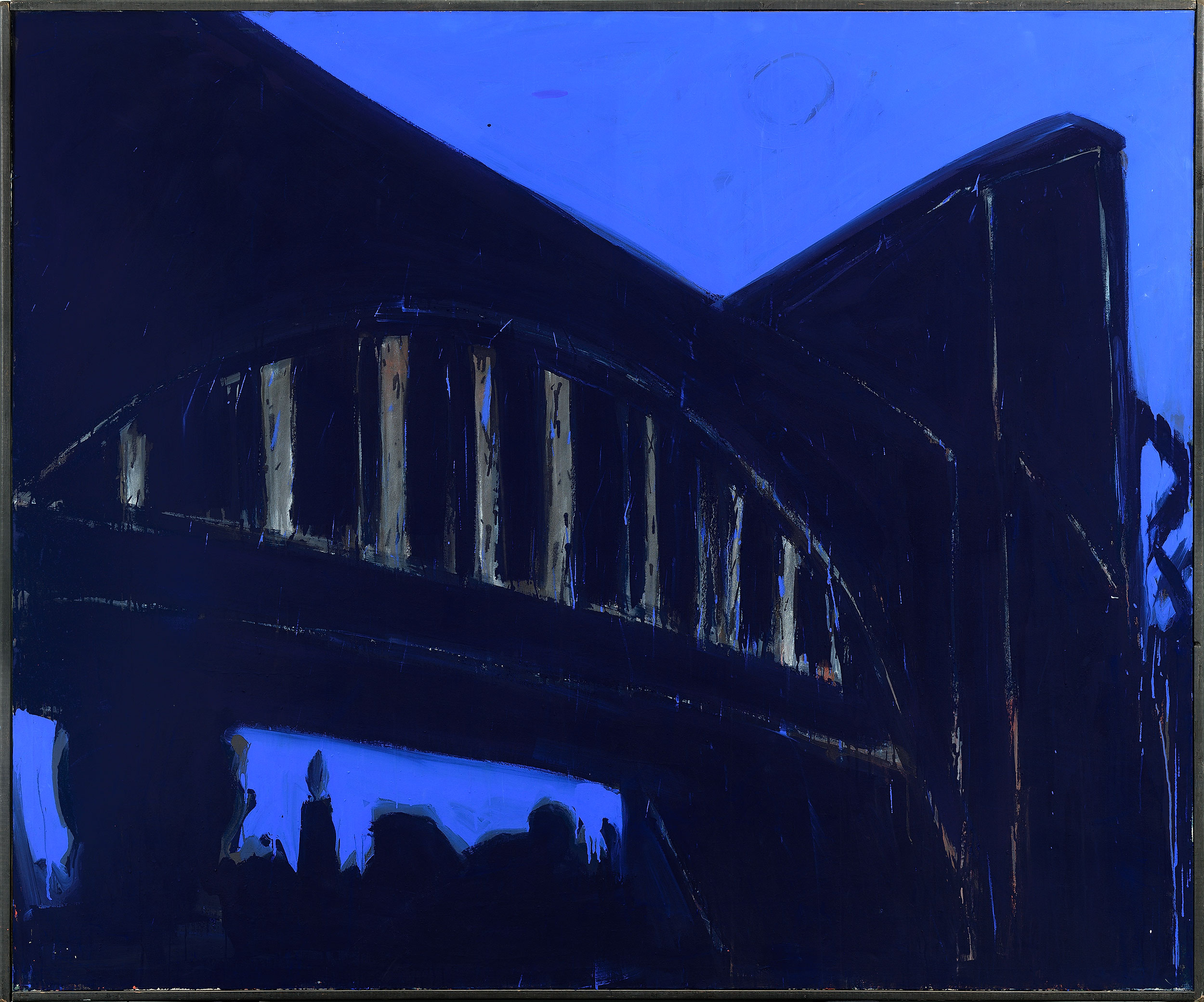
Cette vue nocturne d’une ligne aérienne de chemin de fer, à la fois inquiétante et romantique, renvoie à la thématique des grandes villes, chère aux Expresionnistes allemands tout en alliant le geste spontané des Expresionnistes abstraits. Le titre donné à l’œuvre n’est pas sans rappeler le Die Brücke (Le Pont), l’un des deux groupes fondamentaux de peintres expressionnistes allemands de la première vague, le Der Blaue Reiter (Le Cavalier Bleu formé à Munich en 1911) avec comme figures principales Vassily Kandinsky ou Franz Marc.
190 x 230 cm
Achat, 1985
This night view of an overhead railway line, at once disquieting and romantic, refers to the theme of large cities, dear to the German Expresionnists while combining the spontaneous gesture of the Abstract Expressionists. The title given to the work is reminiscent of Die Brücke (The Bridge), one of the two fundamental groups of German Expressionist painters of the first wave, Der Blaue Reiter (The Blue Rider formed in Munich in 1911) with Vassily Kandinsky and Franz Marc as its main figures.
190 x 230 cm
Achat, 1985
Questa veduta notturna di una linea ferroviaria sopraelevata, allo stesso tempo inquietante e romantica, rimanda al tema delle grandi città, caro agli espressionisti tedeschi, pur combinando il gesto spontaneo degli espressionisti astratti . Il titolo dato all’opera ricorda Die Brücke (Il ponte), uno dei due gruppi fondamentali di pittori espressionisti tedeschi della prima ondata, Der Blaue Reiter (Il cavaliere blu formato a Monaco nel 1911) con Vassily Kandinsky e Franz Marc come figure principali.